Advertisements
Advertisements
Question
Write a composition (in approximately 400-450 words) on the following subject:
During the summer break, you joined a group of young people who read to the elderly at a senior citizens home. Narrate your experience of reading to the elderly and the interactions you had with them. How did this experience impact you?
Advertisements
Solution
Exam tension had at last disappeared over the summer break, allowing space for fun and relaxation. Typical way to relax in my days was games, films and social events: Still, a moment of reflection really hit me. Realising I was living just for myself and not thinking about the wellbeing of others, I wondered why. This insight set off an irresistible need to do social service.
Luckily, I came onto a group committed to visiting an elderly home. Inspired by this, I choose to help by reading to the elderly. I was told I read really brilliantly. I could control my voice and clearly express myself. Characters would come alive and events would become poignantly charged when I read. Snap then made the decision! Reading and recounting it was fantastic.
Thrice in a week, I would visit the old age home and chat to the residents. After that, I would start rereading my best story books with wonderful feeling and sweep them out. I would like to fit the characters by changing my voice and bring life into them. Day by day, more and more individuals came to enjoy listening to me; they would eagerly await my visits. This motivated me to search for fresh, significant dramas with plenty of conflict.
It was a shocker how much the elderly desired company and how much they loved someone spending important events with them. My heart went to an octogenarian who kept a young zeal when it came to mystery stories with lots of suspense, turns and twists. He would tell tales from long ago. He used to be quite a devotee of Agatha Christie's Sherlock Holmes and Hercules Poirot. Given the chances to interact with the children, I came to see they shed their hopelessness and started to enjoy their time with us.
I count my reading times as a gift. This was a moving reminder that the elderly search for compassion, time, a listening ear, and a loving heart rather than worldly pleasures. This encounter has helped me to realise the value of giving our time and attention to people in need instead of wasting it on pointless hobbies.
Remember that ultimately we shall all be in the position of the old, maybe depending on others for different reasons. When that moment comes, we will most certainly value the company, communication, and empathy just as much as they do now. Interacting with the elderly not only improves their quality of life but also helps us to be ready for the future and promotes mutual support and community.
APPEARS IN
RELATED QUESTIONS
Analyse the use of imagery in the poem ‘The Bangle sellers’.
Explain:
‘Some are aglow with the bloom that cleaves
To the limpid glory of new born leaves.’
You are the editor of your school magazine. You have recently attended a cultural program in your city. Write an account of this program (in approximately 300 words) using the points given below:
| Date and venue — occasion — Chief Guest — other invitees — inauguration — events —other important features — highlights — reaction of audience — conclusion. |
Choose two of the passages (a) to (c) and answer briefly the questions that follow:
Raina :
Come away from the window (She takes him firmly back to the middle of the room. The moment she releases him he turns mechanically towards the window again. She seizes him and turns him back, exclaiming) Please! (He becomes motionless, like a hypnotized rabbit, his fatigue gaining fast on him. She releases him, and addresses him patronizingly). Now listen. You must trust to our hospitality. You do not yet know in whose house you are. I am a Petkoff.
The Man: A pet what?
Raina : [rather indignantly] I mean that I belong to the family of the Petkoffs, the richest and best known in our country.
The Man: Oh yes, of course. I beg your pardon. The Petkoffs, to be sure. How stupid of me!
Raina: You know you never heard of them until this moment. How can you stoop to pretend!
The Man: Forgive me. I'm too tired to think, and the change of subject was too much for me. Don't scold me.
(i) Why did the man keep turning to the window?
(ii) Which examples of the social superiority of the Petkoff's does Raina give the man?
(iii) Which opera does Raina mention? With whom does she compare herself? What does this tell you about her?
(iv) In Raina's opinion, what should the man have done instead of threatening her?
(v) What does the man tell Raina about his father? Why does he do so?
(vi) What does the man do at the end of the scene?
Fill in the blank with an appropriate word:
The noise prevented us _______ sleeping.
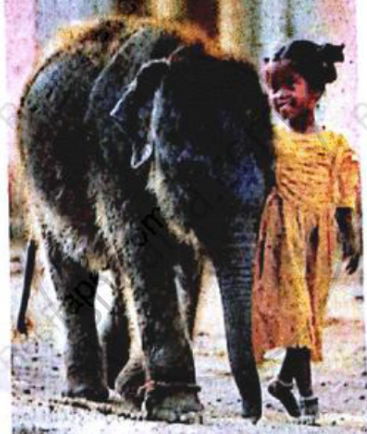
Study the picture given below. Write a story or a description or an account of what it suggests to you. Your composition may be about the subject of the picture or you may take suggestions from it; however, there must be a clear connection between the picture and your composition.
My daughter believes_____________ fairies.
Give reasons for the following.
Tut’s body was buried along with gilded treasures.
Notice the following sentence patterns.
And who art thou? said I to the soft-falling shower.
Rewrite the above sentences in prose.
Locate the following words in the text and study their connotation.
1. gripped the imagination of
2. dawned upon
3. ushered in
4. passed into current coin
5. passport of the future
How did the narrator adjust to the ways of life first in London and then in Cambridge, U.S.A.?
Give reasons for the following.
Satyajit not disclosing his present financial status to his uncle.
Write four to six lines of Free Verse on the topic ‘The road that leads to my college’. Express that it is the road to knowledge and bright future. You may begin like this: Every day I tread with the bag of books …
Find various career opportunities in Small-scale Industries like Handloom, Art and Craft, Block Printing, etc.
What do you know about Kalpana Chawla’s birth, education, a great achievement, and tragic end?
What did the myna do finally?
Re-word the line from the story:
I went to the window which overlooked a large garden.
Imagine your friend/younger brother or sister has committed a grave mistake that has resulted in a great loss to the college property or to your family. He/she seeks your advice to come out of the situation/problem. Write a dialogue between you and your friend/brother/sister who describes the entire situation and seeks help from you. Take the help of the following points.
- Introduction
- Confessing the mistake
- Seeking help
- Your advice/suggestion
- Concluding part
Visit a library. Find a school poem. Recite it to your parents.
Select three words that best describe Mr. Scotti.
clever / unlucky / stupid / successful / miserable / happy.
You lost your geometry box, and someone returns it to you. ______
See the picture Travel Time below. Answer the questions that follow.
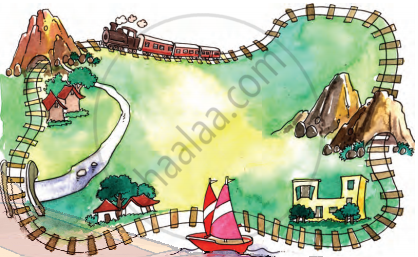
- Where did you go for an excursion/holiday?
- With whom did you go?
- What did you take with you?
- What was the first thing you saw when you reached your destination?
- What did you like best about the place?
- How long did you stay there?
- What did you miss about home?
Now, find and write the antonyms for the words in Box A from the set of words in Box B
| A | B | ||
| amateur | professional | leader | eccentric |
| compulsory | respective | elusive | cheap |
| traditional | unnecessary | supportive | ancillary |
| expensive | hateful | desperate | trivial |
| hopeful | modern | fanciful | repulsive |
| accepted | fulfilled | refused | showered |
| invaluable | novice | optional | |
| complex | antique | determined | |
What was Sletherby’s response to Bertie’s request?
“To me, it is but a worthless bauble.” Why did the photographer’s touch of technical expertise appear a worthless bauble to Leacock?
On returning home, Tishani Doshi writes her thoughts reflecting on how her decision to enrol for the Students on Ice programme has been the single most important decision of her life that has completely transformed her.
Imagine yourself to be Tishani and express these thoughts.
You may begin like this:
I can’t thank my stars enough for having cashed in on the opportunity of........
According to Lorenzo, a man who is unmoved by music is ______.
Work in groups and prepare an attractive wrapper or packet for any product of your choice. Prepare an advertisement for your product.
Do you like cartoons and cartoon films? Which one do you like best?
