Advertisements
Advertisements
Question
Twelve wires each having a resistance of 3 Ω are connected to form a cubical network. A battery of 10 V and negligible internal resistance is connected across the diagonally opposite corners of this network. Determine its equivalent resistance and the current along each edge of the cube.
Advertisements
Solution
A battery of 10 V is connected across the diagonally opposite points a and f of the given network. Each side of the cube represents a 3-ohm resistor. Current entrees through the point a and leaves through the point f. Let I current is drawn from the battery and enters through point a, due to the symmetry of cube between point a and f, the current will divide itself into equal parts at each corner of the cube.
As you can see in the figure given below:
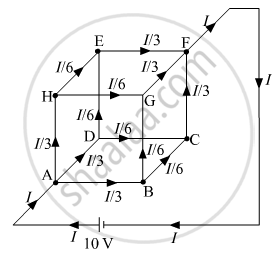
If we consider the current path ABGFA, then we can write, VA-B + VB-G + VG-F = V
⇒ `("I"/3 xx"R") + ("I"/6 xx "R") + ("I"/3 xx "R") = ("I" xx "R"_"net")`
⇒ `"R"_"net" = "R"/3 + "R"/6 + "R"/3 = (5"R")/6`
∵ R = 3Ω
⇒ `"R"_"net" = (5xx3)/6 = 2.5 Ω`
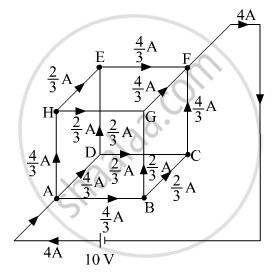
Current, `"i" = "V"/"R"_"net" = 10/2.5 = 4 "A"`
⇒ i = 4 A
As i = 4 A, hence current through each side of the cube can be marked. The below figure shows the current through each resistance of the network. i.e. each side of the cube.
APPEARS IN
RELATED QUESTIONS
Use Kirchhoff's rules to obtain conditions for the balance condition in a Wheatstone bridge.
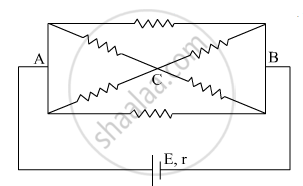
The current is drawn from a cell of emf E and internal resistance r connected to the network of resistors each of resistance r as shown in the figure. Obtain the expression for
- the current draw from the cell and
- the power consumed in the network.
Given the resistances of 1 Ω, 2 Ω, 3 Ω, how will be combine them to get an equivalent resistance of (6/11) Ω?
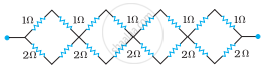
Determine the equivalent resistance of networks shown in Fig.
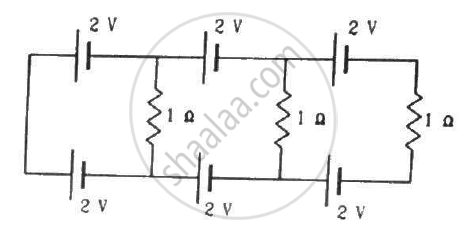
Find the circuit in the three resistors shown in the figure.
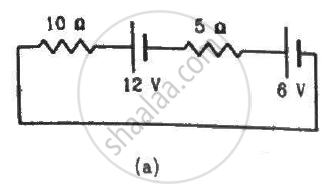
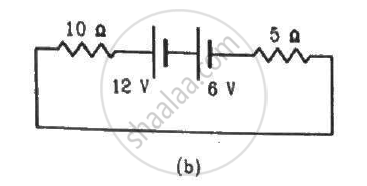
Consider the circuit shown in the figure. Find (a) the current in the circuit (b) the potential drop across the 5 Ω resistor (c) the potential drop across the 10 Ω resistor (d) Answer the parts (a), (b) and (c) with reference to the figure.
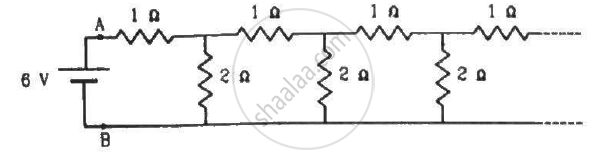
An infinite ladder is constructed with 1 Ω and 2 Ω resistors, as shown in the figure. (a) Find the effective resistance between the points A and B. (b) Find the current that passes through the 2 Ω resistor nearest to the battery.
A potentiometer wire has a length of 4 m and resistance of 20 Ω. It is connected in series with resistance of 2980 Ω and a cell of emf 4 V. Calculate the potential along the wire.
The instrument for the accurate measurement of the e.m.f of a cell is ______.
Kirchhoff’s second law is a consequence of law of conservation of ______.
The Kirchhoff's second law (ΣiR = ΣE), where the symbols have their usual meanings, is based on ______.
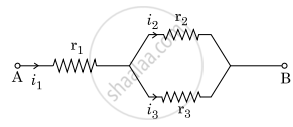
Three resistors having resistances r1, r2 and r3 are connected as shown in the given circuit. The ratio `i_3/i_1` of currents in terms of resistances used in the circuit is:
Three resistors having resistances r1, r2 and r3 are connected as shown in the given circuit. The ratio `"i"_3/"i"_1` of currents in terms of resistances used in the circuit is :
What is the advantage of using thick metallic strips to join wires in a potentiometer?
The circuit in figure shows two cells connected in opposition to each other. Cell E1 is of emf 6V and internal resistance 2Ω; the cell E2 is of emf 4V and internal resistance 8Ω. Find the potential difference between the points A and B.
Two cells of voltage 10V and 2V and internal resistances 10Ω and 5Ω respectively, are connected in parallel with the positive end of 10V battery connected to negative pole of 2V battery (Figure). Find the effective voltage and effective resistance of the combination.

Derive the equation of the balanced state in a Wheatstone bridge using Kirchhoff’s laws.
In the circuit shown in Figure below, E1 and E2 are batteries having emfs of 25V and 26V. They have an internal resistance of 1 Ω and 5 Ω respectively. Applying Kirchhoff’s laws of electrical networks, calculate the currents I1 and I2.

