Advertisements
Advertisements
Question
Draw the orbital diagram of `""_20^40"Ca"^(2+)` ion and state the number of three fundamental particles present in it.
Advertisements
Solution
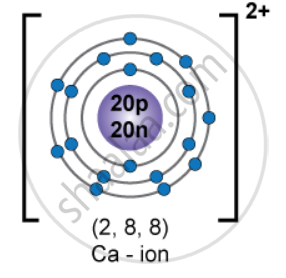
Neutral calcium (Z = 20) has
1s22s22p63s23p64s2
For Ca2+, remove 2 electrons from the outermost 4s orbital:
1s22s22p63s23p6
it has 18 electrons
-
Protons = 20
-
Neutrons = 20
-
Electrons = 18
APPEARS IN
RELATED QUESTIONS
Dalton said that ______ could not be divided.
Multiple Choice Questions
The sum of number of protons and number of neutrons present in the nucleus of an atom is called its
FILL IN THE BLANK
Atomic theory of matter was given by ..........................
In group I of the periodic table, three elements X, Y, and Z have ionic radii 1.33 Å, 0.95 Å and 0.60 Å respectively. Giving a reason, arrange them in the order of increasing atomic number in the group.
The atomic number and mass number of sodium are 11 and 23 respectively. What information is conveyed by this statement?
An element ‘A’ has mass number 23 and atomic number 11. State the –
- no. of neutrons in its shell,
- electronic configuration of the element ‘A’.
The No. of electrons in the outermost shell of the atom of an inert gas ______.
Match the following:
| Column A | Column B | ||
| 1. | Mass of proton | a. | +1 |
| 2. | Mass of electron | b. | -1 |
| 3. | Charge of electron | c. | 9.31 x 10⁻²⁸g |
| 4. | Charge of proton | d. | 1.67 x 10⁻²⁴g |
What are the letters A, Z, and X stand for?
In which one of the following, the number of protons is greater than the number of neutrons but number of protons is less than the number of electrons?
