Advertisements
Advertisements
Question
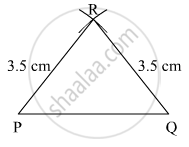
Draw an isosceles triangle with base 5 cm and the other sides 3.5 cm each.
Advertisements
Solution
Steps of construction:
- Draw a line PQ = 5 cm.
- With P as a centre and 3.5 cm as radius, draw an arc above the line PQ.
- With Q as a centre and 3.5 cm as radius, draw an arc cutting the previously drawn arc. Name the point of intersection as point R.
- Join RP and RQ.
△RPQ is the required isosceles triangle.
RELATED QUESTIONS
Construct a triangle of the measures given below.
Construct a triangle using the given data: DE = 6.5cm, EF = 5.8cm and DF = 4.2cm
Construct a triangle using the given data: BC = 6cm, AC = 5.0cm and ∠C = 60°
Construct a triangle using the given data: XY = 5.2cm, XZ = 6.5cm and ∠X = 75°
Construct an isosceles triangle in which: AB = AC, BC = 6 cm and ∠B = 75°
Construct an isosceles triangle in which: XY = XZ, YZ = 5.5 cm and ∠X = 60°
Construct an isosceles triangle in which: PQ = QR, PR = 4.5 cm and ∠R = 60°
Construct an equilateral triangle using the given data: Altitude AD = 5 cm
For Construction of △ABC where AB = 4 cm, ∠A = 60°, and ∠B = 30°, what is the critical step used to locate vertex C?
In Construction of △ABC where AB = 3 cm, BC = 5 cm, and ∠ABC = 60°, which side must be drawn first as the base?
