Advertisements
Advertisements
Question
Discuss the following case:
Source in motion and Observer at rest
- Source moves towards observer
- Source moves away from the observer
Advertisements
Solution
(a) Source moves towards die observer-
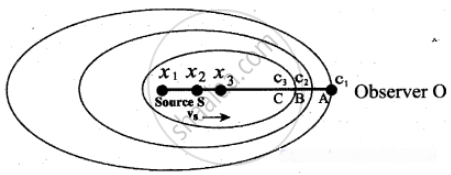
Source S moves towards an observer O (right) with velocity
Suppose a source S moves to the right (as shown in Figure) with a velocity vs and let the frequency of the sound waves produced by the source be fs. It is assumed that the velocity of sound in a medium is v.
Suppose a source S moves to the right (as shown in Figure) with a velocity vs and let the frequency of the sound waves produced by the source be fs. It is assumed that the velocity of sound in a medium is v.
The compression (sound wavefront) produced by the source S at three successive instants of time are shown in the Figure. When S is at position x1 the compression is at C1. When S is at position x2, the compression is at C2 and similarly for x3 and C3.
It is meant that the wavelength decreases when the source S moves towards the observer O. But frequency is inversely related to wavelength and therefore, frequency increases.
Calculation:
Let λ be the wavelength of the source S as measured by the observer when S is at position x1 and λ’ be the wavelength of the source observed by the observer when S moves to position x2.
Then the change in wavelength is ∆λ = λ – λ’ = vst, where t is the time taken by the source to travel between x1 and x2 Therefore,
λ’ = λ – vst … (1)
But t = \[\frac{λ}{v}\] … (2)
On substituting equations (2) in equation (1), we get.
`lambda' = lambda(1 - "v"_"s"/"v")`
Since frequency is inversely proportional to wavelength, we have
`"f"' = "v"_"s"/(lambda')` and f = `"v"_"s"/lambda`
Hence `"f"' = "f"/((1 - "v"_"s"/"v"))` ...(3)
Since, `"v"_"s"/"v"` << 1, by using the binomial expansion and retaining only first order in `"v"_"s"/"v"`, we get
`"f"' = "f"(1 + "v"_"s"/"v")` ...(4)
(b) Source moves away from the observer-
Since the velocity of the source is opposite in direction when compared to case (a), hence by changing the sign of the velocity of the source in the above case i.e., by substituting (vs → – v ) in equation (1), we get
`"f"' = "f"/((1 + "v"_"s"/"v"))` ....(5)
Using binomial expansion again, we get
`"f"' = "f"(1 - "v"_"s"/"v")` .....(6)
APPEARS IN
RELATED QUESTIONS
Answer briefly.
State the expression for apparent frequency when the source is stationary and the listener is
- moving towards the source
- moving away from the source
The speed of a wave in a certain medium is 900 m/s. If 3000 waves passes over a certain point of the medium in 2 minutes, then compute its wavelength?
Consider a mixture of 2 mol of helium and 4 mol of oxygen. Compute the speed of sound in this gas mixture at 300 K.
The difference between the apparent frequency of a source of sound as perceived by the observer during its approach and recession is 2% of the frequency of the source. If the speed of sound in air is 300 ms-1, then the velocity of the source is ______.
A bus is moving with a velocity of 5 m is towards a wall. The driver blows the horn of frequency 165 Hz. If the speed of sound in air is 335 m is, then after reflection of sound wave, the number of beats per second heard by the passengers in the bus will be ______.
If a star appearing yellow starts accelerating towards the earth, its colour appears to be turned ______.
In a quink tube experiment, a tuning fork of frequency 300 Hz is vibrated at one end. It is observed that intensity decreases from maximum to 50% of its maximum value, as tube is moved by 6.25 cm. Velocity of sound is ______ m/s.
The frequency of echo will be ______ Hz if the train blowing a whistle of frequency 320 Hz is moving with a velocity of 36 km/h towards a hill from which an echo is heard by the train driver. The velocity of sound in air is 330 m/s.
A whistle producing sound waves of frequencies 9500 Hz and above is approaching a stationary person with speed v ms-1. The velocity of sound in air is 300 ms-1. If the person can hear frequencies up to a maximum of 10,000 HZ, the maximum value of v up to which he can hear the whistle is ______.
The observer is moving with velocity 'v0' towards the stationary source of sound and then after crossing moves away from the source with velocity 'v0'. Assume that the medium through which the sound waves travel is at rest. If v is the velocity of sound and n is the frequency emitted by the source, then the difference between apparent frequencies heard by the observer is ______.
