Advertisements
Advertisements
प्रश्न
Discuss the following case:
Source in motion and Observer at rest
- Source moves towards observer
- Source moves away from the observer
Advertisements
उत्तर
(a) Source moves towards die observer-
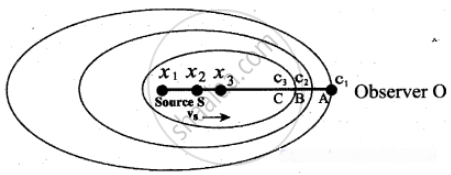
Source S moves towards an observer O (right) with velocity
Suppose a source S moves to the right (as shown in Figure) with a velocity vs and let the frequency of the sound waves produced by the source be fs. It is assumed that the velocity of sound in a medium is v.
Suppose a source S moves to the right (as shown in Figure) with a velocity vs and let the frequency of the sound waves produced by the source be fs. It is assumed that the velocity of sound in a medium is v.
The compression (sound wavefront) produced by the source S at three successive instants of time are shown in the Figure. When S is at position x1 the compression is at C1. When S is at position x2, the compression is at C2 and similarly for x3 and C3.
It is meant that the wavelength decreases when the source S moves towards the observer O. But frequency is inversely related to wavelength and therefore, frequency increases.
Calculation:
Let λ be the wavelength of the source S as measured by the observer when S is at position x1 and λ’ be the wavelength of the source observed by the observer when S moves to position x2.
Then the change in wavelength is ∆λ = λ – λ’ = vst, where t is the time taken by the source to travel between x1 and x2 Therefore,
λ’ = λ – vst … (1)
But t = \[\frac{λ}{v}\] … (2)
On substituting equations (2) in equation (1), we get.
`lambda' = lambda(1 - "v"_"s"/"v")`
Since frequency is inversely proportional to wavelength, we have
`"f"' = "v"_"s"/(lambda')` and f = `"v"_"s"/lambda`
Hence `"f"' = "f"/((1 - "v"_"s"/"v"))` ...(3)
Since, `"v"_"s"/"v"` << 1, by using the binomial expansion and retaining only first order in `"v"_"s"/"v"`, we get
`"f"' = "f"(1 + "v"_"s"/"v")` ...(4)
(b) Source moves away from the observer-
Since the velocity of the source is opposite in direction when compared to case (a), hence by changing the sign of the velocity of the source in the above case i.e., by substituting (vs → – v ) in equation (1), we get
`"f"' = "f"/((1 + "v"_"s"/"v"))` ....(5)
Using binomial expansion again, we get
`"f"' = "f"(1 - "v"_"s"/"v")` .....(6)
APPEARS IN
संबंधित प्रश्न
Answer briefly.
State the expression for apparent frequency when the source is stationary and the listener is
- moving towards the source
- moving away from the source
Explain red shift and blue shift in Doppler Effect.
The speed of a wave in a certain medium is 900 m/s. If 3000 waves passes over a certain point of the medium in 2 minutes, then compute its wavelength?
A source of sound is moving with constant velocity of 30 mis emitting a note of frequency 256 Hz. The ratio of frequencies observed by a stationary observer while the source is approaching him and after it crosses him is ______. (speed of sound in air = 330 m/s)
An observer moves towards a stationary source of sound with a velocity one-fifth of the velocity of sound. The percentage increase in the apparent frequency heard by the observer will be ______.
With what velocity an observer should move relative to a stationary source so that a sound of double the frequency of source is heard by an observer?
When a sound source of frequency n is approaching a stationary observer with velocity u than the apparent change in frequency is Δn1 and when the same source is receding with velocity u from the stationary observer than the apparent change in frequency is Δn2. Then ______.
When an engine passes near to a stationary observer then its apparent frequencies occurs in the ratio 5/3. If the velocity of engine is ______.
A racing car moving towards a cliff sounds its horn. The sound reflected from the cliff has a pitch one octave higher than the actual sound of the horn. If V is the velocity of sound, the velocity of the car is ______.
The pitch of the whistle of an engine appears to drop by 20% of its original value when it passes a stationary observer. If the speed of sound in the air is 350 m/s, then the speed of the engine (in m/s) is ______.
