Advertisements
Advertisements
Question
Determine whether the points are collinear.
L(–2, 3), M(1, –3), N(5, 4)
Advertisements
Solution
L(–2, 3), M(1, –3), N(5, 4)
According to distance formula,
d(L, M) = `sqrt((x_2 – x_1)^2 + (y_2 – y_1)^2)`
d(L, M) = `sqrt([1 – (–2)]^2 + (–3 – 3)^2)`
d(L, M) = `sqrt((1 + 2)^2 + (–3 – 3)^2)`
d(L, M) = `sqrt((3)^2 + (–6)^2)`
d(L, M) = `sqrt(9 + 36)`
d(L, M) = `sqrt(45)`
d(L, M) = `sqrt(9 × 5)`
∴ d(L, M) = `3sqrt(5)` ...(1)
d(M, N) = `sqrt((x_2 – x_1)^2 + (y_2 – y_1)^2)`
d(M, N) = `sqrt((5 – 1)^2 + [4 – (– 3)]^2)`
d(M, N) = `sqrt((5 – 1)^2 + (4 + 3)^2)`
d(M, N) = `sqrt((4)^2 + (7)^2)`
d(M, N) = `sqrt(16 + 49)`
∴ d(M, N) = `sqrt(65)` ...(2)
d(L, N) = `sqrt((x_2 – x_1)^2 + (y_2 – y_1)^2)`
d(L, N) = `sqrt([5 – (– 2)]^2 + (4 – 3)^2)`
d(L, N) = `sqrt((5 + 2)^2 + (4 – 3)^2)`
d(L, N) = `sqrt((7)^2 + (1)^2)`
d(L, N) = `sqrt(49 + 1)`
d(L, N) = `sqrt(50)`
d(L, N) = `sqrt(25 × 2)`
∴ d(L, N) = `5sqrt(2)` ...(3)
From (1), (2), and (3),
Sum of two sides is not equal to the third side.
Hence, the given points are not collinear.
APPEARS IN
RELATED QUESTIONS
If A(4, 3), B(-1, y) and C(3, 4) are the vertices of a right triangle ABC, right-angled at A, then find the value of y.
Find the coordinates of the circumcentre of the triangle whose vertices are (8, 6), (8, – 2) and (2, – 2). Also, find its circum radius
The value of 'a' for which of the following points A(a, 3), B (2, 1) and C(5, a) a collinear. Hence find the equation of the line.
Given a line segment AB joining the points A(–4, 6) and B(8, –3). Find
1) The ratio in which AB is divided by y-axis.
2) Find the coordinates of the point of intersection.
3) The length of AB.
Find all possible values of x for which the distance between the points A(x, –1) and B(5, 3) is 5 units.
Using the distance formula, show that the given points are collinear:
(1, –1), (5, 2) and (9, 5)
If P(x, y) is equidistant from the points A(7, 1) and B(3, 5), find the relation between x and y.
Prove that the points (7 , 10) , (-2 , 5) and (3 , -4) are vertices of an isosceles right angled triangle.
Prove that the points (0 , 0) , (3 , 2) , (7 , 7) and (4 , 5) are the vertices of a parallelogram.
Prove that the points (a, b), (a + 3, b + 4), (a − 1, b + 7) and (a − 4, b + 3) are the vertices of a parallelogram.
PQR is an isosceles triangle . If two of its vertices are P (2 , 0) and Q (2 , 5) , find the coordinates of R if the length of each of the two equal sides is 3.
Find the distance between the origin and the point:
(-8, 6)
A point P lies on the x-axis and another point Q lies on the y-axis.
If the abscissa of point P is -12 and the ordinate of point Q is -16; calculate the length of line segment PQ.
The length of line PQ is 10 units and the co-ordinates of P are (2, -3); calculate the co-ordinates of point Q, if its abscissa is 10.
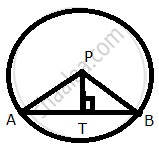
Point P (2, -7) is the centre of a circle with radius 13 unit, PT is perpendicular to chord AB and T = (-2, -4); calculate the length of AB.
Use distance formula to show that the points A(-1, 2), B(2, 5) and C(-5, -2) are collinear.
The distance between points P(–1, 1) and Q(5, –7) is ______.
The distance between the points A(0, 6) and B(0, –2) is ______.
Name the type of triangle formed by the points A(–5, 6), B(–4, –2) and C(7, 5).
|
Case Study Trigonometry in the form of triangulation forms the basis of navigation, whether it is by land, sea or air. GPS a radio navigation system helps to locate our position on earth with the help of satellites. |

- Make a labelled figure on the basis of the given information and calculate the distance of the boat from the foot of the observation tower.
- After 10 minutes, the guard observed that the boat was approaching the tower and its distance from tower is reduced by 240(`sqrt(3)` - 1) m. He immediately raised the alarm. What was the new angle of depression of the boat from the top of the observation tower?
