Advertisements
Advertisements
Question
Describe Mr Wonka.
Advertisements
Solution
Mr Willy Wonka was a strange man. He used to make all strange inventions. He had a subordinate called Charlie. There was Oompa- Loompa volunteers on whom he used to carry out the testing of his inventions.
He had an Inventing Room where he carried out all such mysterious works.
He had earlier invented Wonka-Vite that had made people younger to an extent that their ages have gone into minus and they have become invisible.
He then invented Vita-Wonk after collecting ancient items from across the world which could help people grow older.
RELATED QUESTIONS
While packing the hamper, George and Harris do a number of foolish and funny thing. Tick the statements that are true.
(i) They started with breaking a cup.
(ii) They also broke a plate.
(iii) They squashed a tomato.
(iv) They trod on the butter.
(v) They stepped on a banana.
(vi) They put things behind them, and couldn’t find them.
(vii) They stepped on things.
(viii) They packed the pictures at the bottom and put heavy things on top.
(ix) They upset almost everything.
(x) They were very good at packing.
Pick out word from the text that mean the same as the following word or expression. (Look in the paragraph indicated.)
the usual way of doing things : _________
Sometimes the choices we make have far-reaching consequences. Think about choices you make on a daily basis, and the importance of these choices.
Old Kaspar took it from the boy,
Who stood expectant by;
And then the old man shook his head,
And,with a natural sigh,
"Tis some poor fellow's skull," said he,
"Who fell in the great victory.
"I find them in the garden,
For there's many here about;
And often when I go to plough,
The ploughshare turns them out!
For many thousand men,"said he,
"Were slain in that great victory."
Read the lines given above and answer the question that follow.
What words show that there were many such skulls to be found there?
"Now tell us what 'twas all about,"
Young Peterkin, he cries;
And little wilhelmine looks up
with wonder-waiting eyes;
"Now tell us all about the war,
And what they fought each other for."
"It was the English," Kaspar cried,
"Who put the French to rout;
But what they fought each other for,
I could not well make out;
But everybody said,"quoth he,
"That 'twas a famous victory.
Read the lines given above and answer the question that follow.
Name the two opposing sides. Who won?
Describe the stranger who came to the pet shop. What did he want?
Who does he say the kitten’s ancestors are? Do you believe him?
Complete the sentence below by appropriately using anyone of the following:
if you want to/if you don’t want to/if you want him to
Don’t go to the theatre__________________.
Why was the name plate missing at Mr Gessler’s shop?
Why did Soapy like to go to the prison?
Why were the sunrays keen to go down to the earth the next day?
Why was Dad sure he wouldn’t fall?
Use the clues given below to complete this crossword puzzle.
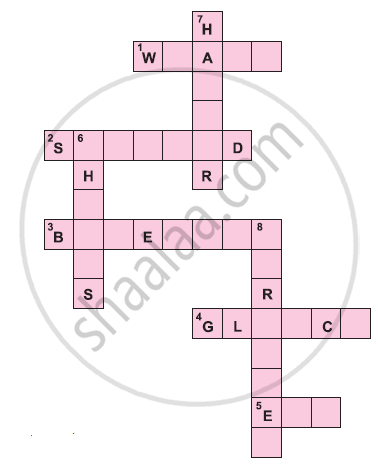
Across
1. very tired
2. had an angry look on the face
3. short trousers
4. a fault in a machine that prevents it from working properly
5. a small and naughty boy-fairy
Down
6. work that must be done every day, often boring
7. a basket with a lid
8. gave a short, high-pitched cry
Multiple Choice Question:
Who is the poet of this poem?
Read the following line.
Some Whatifs crawled inside my ear
Can words crawl into your ear? This is an image. The poet is trying to make an image of what she/he experiences. Now with your partner try and list out some more images from the poem.
What does Nishad find out about Mr Nath from Ramesh?
Arrange the information as suggested below.
- What he eats
- When he eats
- What he drinks and when
- How he pays
What was announced on the loudspeakers before the start of the race in the poem, ‘Nine Gold Medals’?
Complete the following sentence by providing a reason:
In the poem, Dover Beach, the poet wants his beloved to be "true" to him because ______.
Read the following passage carefully and answer the questions that follow:
|
One day I found the pond occupied by several buffaloes. Their keeper, a boy a little older than me, was swimming about in the middle. Instead of climbing out on the bank, he would pull himself up on the back of one of his buffaloes, stretch his naked brown body out on the animal’s glistening hide, and start singing to himself. When he saw me staring at him from across the pond, he smiled, showing gleaming white teeth in a dark face. He invited me to join him in a swim. I told him I couldn’t swim, and he offered to teach me. His name was Ramu, and he promised to give me swimming lessons every afternoon, and so it was during the afternoons — especially summer afternoons when everyone was asleep — that we usually met. Before long I was able to swim across the pond to sit with Ramu astride a contented buffalo. Sometimes I would slip into the water. Emerging in shades of green and khaki, I would sneak into the house through the bathroom and bathe under the tap before getting into my clothes. One afternoon Ramu and I found a small tortoise in the mud, sitting over a hole in which it had laid several eggs. I presented the tortoise to Grandfather. He had a weakness for tortoises, and was pleased with this addition to his menagerie, giving it a large tub of water all to itself, with an island of rocks in the middle. If one of the dogs bothered it too much, it would draw its head and legs into its shell and defy all its attempts at rough play. Ramu came from a family of bonded labourers and had received no schooling. But he was well-versed in folklore and knew a great deal about birds and animals. “Many birds are sacred,” said Ramu, as we watched a blue jay swoop down from a peepul tree and carry off a grasshopper. Both Ramu and Grandfather were of the opinion that we should be more gentle with birds and animals and should not kill so many of them. “It is also important that we respect them, said Grandfather. We must acknowledge their rights. Birds and animals are finding it more difficult to survive, because we are trying to destroy both them and their forests.” Ramu and I spent long summer afternoons at the pond. I still remember him with affection, though we never saw each other again after I left Dehra. |
- For each word given below choose the correct meaning (as used in the passage) from the options provided: [2]
- hide (line 4)
- blanket
- fur
- undisclosed
- skin
- contented (line 12)
- cheerful
- lazy
- satisfied
- container
- hide (line 4)
- Which word in the passage is the opposite of ‘easy’? [1]
- sneak
- difficult
- labourer
- survive
- Answer the following questions briefly in your own words.
- What did Ramu like to do once he had climbed on the back of a buffalo? [2]
- What offer did Ramu make to the narrator? [2]
- Why do you think the narrator would bathe before entering the house? [2]
- Who was the large tub of water for? [1]
- How would the tortoise protect itself from the dogs? [2]
- Despite the lack of schooling what did Ramu know? How, according to Ramu and Grandfather, should we treat birds and animals? Answer in not more than fifty words. [8]
Analyse the comparison between death and sleep in the poem, Death Be Not Proud. How does this metaphor contribute to the overall message of the sonnet? Write your answer in about 200-250 words.
