Advertisements
Advertisements
Question
Describe different steps involved in tissue culture technique
Advertisements
Solution
1)Explant culture: Proper explant is excised from the plant which may be a cell, tissue or a piece of the plant organ. Generally, parenchyma tissue or meristem is used as explants. The cells from explant absorb nutrients and start multiplying to form callus. Callus is the unorganised mass of cells
2) Sterilization: In tissue culture technique, different apparatus, the medium used and the explant also is to be properly sterilized to avoid the contamination due to which the experiment may fail. The methods used for sterilization may be dry or wet sterilization, Alcohol sterilization etc. The explants used can be sterilized by using 1% sodium hypochlorite or 70% ethyl alcohol or 10% hydrogen peroxide
3) Organogenesis: Now the growth hormones like auxins and cytokinins in proper proportion are provided to the callus to induce the formation of organs. If auxins are more, roots are formed (rhizogenesis) and if the cytokinins are in more quantity then the shoot system begins to develop (caulogenesis).
APPEARS IN
RELATED QUESTIONS
How are somatic hybrids obtained?
Give two examples where micropropagation is commercially adopted
Mention two advantages of the micropropagation technique.
Explain the transpiration pull theory for an ascent of sap
What is a clone?
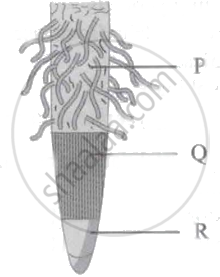
Identify labels P, Q, R in the given figure of root showing different regions.
To isolate protoplast, one needs ______.
How is a somatic hybrid different from a hybrid?
Plants raised through tissue cultures are clones of the ‘parent’ plant. Discuss the utility of these plants.
Explain the concept of tissue culture.
