Define the term ‘work input’ and ‘work output’ in relation to a machine.
Advertisements
Question
Define the term ‘work input’ and ‘work output’ in relation to a machine.
Advertisements
Solution
Work input is work done on a machine equal to the effort force times the distance through which the force is applied.
Work output is work that is done by a machine and equals resistance force times the distance through which the force is applied.
For an ideal machine, the work output is equal to the work input, i.e., the efficiency.
APPEARS IN
RELATED QUESTIONS
Select the correct alternative:
For an ideal machine, the efficiency is
Answer the following.
What is a machine?
Give an example of the following uses of a machine:
to obtain gain in speed
Fig show a system of four pulleys. The upper two pulleys are fixed and the lower two are movable.
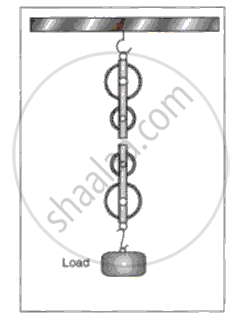
(i) Draw a string around the pulleys. Also show the place and direction in which the effort is applied.
(ii) What is the velocity ratio of the system?
(iii) What is the mechanical advantage of the system?
(iv) What assumption do you make in arriving at your answer in part (iii)?
Can a simple machine act as a force multiplier and a speed multiplier at the same time?
What is the relationship between the mechanical advantage and the velocity ratio for:
- An ideal machine,
- A practical machine.
How does a machine work?
(i) Calculate the mechanical advantage of the lever shown in the figure.
(ii) How do you define the mechanical advantage of a machine?

A simple machine enables us to lift a load of 10,000 N by the application of an effort of 500 N. However, when the point of application of the effort moves through 2.5 m, the load gets raised through 10 cm only. What are the values of the:
(i) M.A.
(ii) V.R. and
(iii) Efficiency of the machine?
Simple machines usually exchange a larger force to move a heavy object.
