Advertisements
Advertisements
Question
The ______ in the centre, the ______ on one side and the ______ on the other side make a lever of the second order.
Advertisements
Solution
The load in the centre, the fulcrum on one side and the effort on the other side make a lever of the second order.
APPEARS IN
RELATED QUESTIONS
State whether the following statement is True or False.
A machine performs work by itself.
What is the purpose of a jack in lifting a car by it?
Fig show a system of four pulleys. The upper two pulleys are fixed and the lower two are movable.
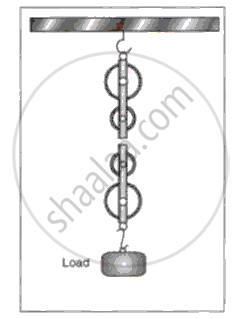
(i) Draw a string around the pulleys. Also show the place and direction in which the effort is applied.
(ii) What is the velocity ratio of the system?
(iii) What is the mechanical advantage of the system?
(iv) What assumption do you make in arriving at your answer in part (iii)?
Give scientific reason for the following:
Passengers in a bus are pushed backward when it starts suddenly.
Write an expression to show the relationship between mechanical advantage, velocity ratio, and efficiency for a simple machine.
Write an expression for the mechanical advantage of an inclined plane.
(i) Calculate the mechanical advantage of the lever shown in the figure.
(ii) How do you define the mechanical advantage of a machine?

Classify the following as a lever, a pulley and an inclined plane:
A staircase
Classify the following as a lever, a pulley and an inclined plane:
A slide
Why is this so traveller’s bags have wheels?
