Advertisements
Advertisements
Question
Define the Stationary phase.
Advertisements
Solution
Stationary phase is a solid or a liquid supported on a solid which remains fixed in a place and on which different solutes are adsorbed to a different extent.
APPEARS IN
RELATED QUESTIONS
Give a brief description of the principle of the following technique taking an example.
Chromatography
Explain the principle of paper chromatography.
The best and latest technique for isolation, purification and separation of organic compounds is ______.
What is chromatography?
What are the advantages of chromatography?
Name the simplest type of chromatography?
On what principle is Chromatography method based?
Name the different types of chromatographic techniques.
Give a scientific reason.
In chromatography, the ingredients of a mixture rise up to limited height water rises up to the upper end of the paper.
Give a reason for the following statement:
In chromatography the absorbent medium e.g. What man filter paper is known as the stationary phase.
Give names of two materials used as stationary phase in chromatography.
How do you visualize colourless compounds after separation in TLC and Paper Chromatography?
Compare TLC and Paper Chromatography techniques.
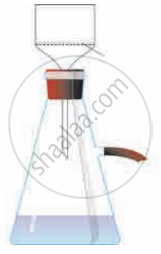
Label the diagram and explain the process in your words.
Chromatography is based on the principle of ______.
The principle involved in paper chromatography is ______.
What is paper chromatography?
Which one of the following techniques is not used to spot components of a mixture separated on thin layer chromatographic plate?
Complex mixtures are separated by ______.
Which basic principle is used in chromatography?
What is the function of the stationary phase in chromatography?
In chromatography, the mobile phase is usually ______.
