Advertisements
Advertisements
Question
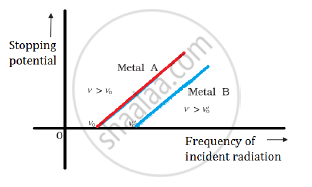
Define (i) stopping potential and (ii) threshold frequency, using Einstein’s equation and drawing necessary plot between relevant quantities.
Advertisements
Solution
Stopping potential: For a particular frequency of incident radiation, the minimum negative (retarding) potential V0 for which the photocurrent stops or becomes zero is called the cut-off or stopping potential.
Threshold frequency: The minimum frequency required for photoelectrons to be emitted from a metal surface is called the threshold frequency.
The graph between stopping potential and frequency of incident radiation is shown below:
APPEARS IN
RELATED QUESTIONS
The threshold wavelength of silver is 3800Å. Calculate the maximum kinetic energy in eV of photoelectrons emitted, when ultraviolet light of wavelength 2600Å falls on it.
(Planck’s constant, h =6.63 x 1O-34J.s.,
Velocity of light in air, c = 3 x 10⁸ m / s)
The photoelectric threshold wavelength of a metal is 230 nm. Determine the maximum kinetic energy in joule and in eV of the ejects electron for the metal surface when it is exposed to a radiation of wavelength 180 nm.
[Planck’s constant : h = 6.63 * 10-34 Js, Velocity of light : C = 3 * 108 m/s.]
Find the value of energy of electron in eV in the third Bohr orbit of hydrogen atom.
(Rydberg's constant (R) = 1· 097 x 107m - 1,Planck's constant (h) =6·63x10-34 J-s,Velocity of light in air (c) = 3 x 10⁸m/ s.)
State two important properties of photon which are used to write Einstein’s photoelectric equation.
Write the basic features of photon picture of electromagnetic radiation on which Einstein’s photoelectric equation is based.
Which of the following graphs correctly represents the variation of maximum kinetic energy (Ek) of photoelectrons with the frequency (𝜈) of the incident radiation?
Einstein work on the photoelectric effect provided support for the eqn:-
The slope of frequency of incident light and stopping potential for a given surface will be
The emission of electron is possible
The wavelength of matter is independent of
