मराठी

Define Stopping Potential and Threshold Frequency, Using Einstein’S Equation and Drawing Necessary Plot Between Relevant Quantities. - Physics

Advertisements
Advertisements

प्रश्न

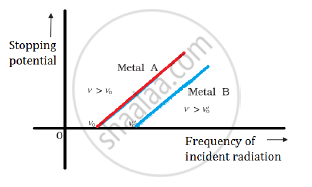
Define (i) stopping potential and (ii) threshold frequency, using Einstein’s equation and drawing necessary plot between relevant quantities.

Advertisements

उत्तर

Stopping potential: For a particular frequency of incident radiation, the minimum negative (retarding) potential V0 for which the photocurrent stops or becomes zero is called the cut-off or stopping potential.

Threshold frequency: The minimum frequency required for photoelectrons to be emitted from a metal surface is called the threshold frequency.

The graph between stopping potential and frequency of incident radiation is shown below:
shaalaa.com
  या प्रश्नात किंवा उत्तरात काही त्रुटी आहे का?
2015-2016 (March) All India Set 3 N

संबंधित प्रश्‍न

The threshold wavelength of silver is 3800Å. Calculate the maximum kinetic energy in eV of photoelectrons emitted, when ultraviolet light of wavelength 2600Å falls on it.

(Planck’s constant, h =6.63 x 1O-34J.s.,

Velocity of light in air, c = 3 x 10⁸ m / s)


When radiations of wavelength λ1 and λ2 are incident on certain photosensitive, such that E1 > E2 . Then Planck's constant 'h' is ......................... .

(C = Velocity of light).


State two important properties of photon which are used to write Einstein’s photoelectric equation.


Write Einstein's photoelectric equation and mention which important features in photoelectric effect can be explained with the help of this equation.

The maximum kinetic energy of the photoelectrons gets doubled when the wavelength of light incident on the surface changes from λ1 to λ2. Derive the expressions for the threshold wavelength λ0 and work function for the metal surface.


Write its S.I. unit of (intensity of radiation)


Radiation of frequency 1015 Hz is incident on two photosensitive surface P and Q. There is no photoemission from surface P. Photoemission occurs from surface Q but photoelectrons have zero kinetic energy. Explain these observations and find the value of work function for surface Q.


Dimensions of ‘resistance’ are same as (where h is Planck's constant and e is charge):


(i) A ray of light incident on face AB of an equilateral glass prism, shows minimum deviation of 30°. Calculate the speed of light through the prism.

(ii) Find the angle of incidence at face AB so that the emergent ray grazes along the face AC.


  1. Calculate the frequency of a photon of energy 6.5 × 10⁻¹⁹ J.
  2. Can this photon cause the emission of an electron from the surface of Cs of work function 2.14 eV? If yes, what will be the maximum kinetic energy of the photoelectron?

The graphs below show the variation of the stopping potential VS with the frequency (ν) of the incident radiations for two different photosensitive materials M1 and M2.

Express work function for M1 and M2 in terms of Planck’s constant(h) and Threshold frequency and charge of the electron (e).

If the values of stopping potential for M1 and M2 are V1 and V2 respectively then show that the slope of the lines equals to `(V_1-V_2)/(V_(01)-V_(02))` for a frequency,

ν > ν02 and also ν > ν01


Share
Notifications

Englishहिंदीमराठी


      Forgot password?
Use app×