Advertisements
Advertisements
प्रश्न
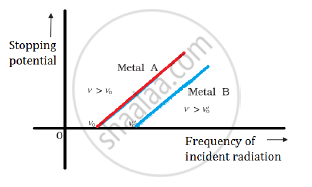
Define (i) stopping potential and (ii) threshold frequency, using Einstein’s equation and drawing necessary plot between relevant quantities.
Advertisements
उत्तर
Stopping potential: For a particular frequency of incident radiation, the minimum negative (retarding) potential V0 for which the photocurrent stops or becomes zero is called the cut-off or stopping potential.
Threshold frequency: The minimum frequency required for photoelectrons to be emitted from a metal surface is called the threshold frequency.
The graph between stopping potential and frequency of incident radiation is shown below:
APPEARS IN
संबंधित प्रश्न
The energy of photon of wavelength X is_____ .
[h = Planck’s constant, c = speed of light in vacuum]
The work function for a metal surface is 2.2eV. If the light of wavelength 5000Å is incident on the surface of the metal, find the threshold frequency and incident frequency. Will there be an emission of photoelectrons or not? (c = 3 x 10⁸ m/ s, 1eV = 1.6x10⁻¹⁹ J , h = 6.63 x 10⁻³⁴ J.s.)
According to Einstein’s model, the threshold frequency for a metal having work function ϕ0 is given by _________.
If the frequency of light in a photoelectric experiment is double the stopping potential will
If the energy of photon corresponding to a wavelength of 6000 A° is 3.32 × 10⁻¹⁹ J, the photon energy for a wavelength of 4000 A° will be ______.
What will be wavelength of a photon of momentum 6.6 × 10⁻²⁴ kgms–1?
- Calculate the frequency of a photon of energy 6.5 × 10⁻¹⁹ J.
- Can this photon cause the emission of an electron from the surface of Cs of work function 2.14 eV? If yes, what will be the maximum kinetic energy of the photoelectron?
How does stopping potential in photoelectric emission vary if the intensity of the incident radiation increases?
How does stopping potential in photoelectric emission vary if the frequency of incident radiation decreases?
The graphs below show the variation of the stopping potential VS with the frequency (ν) of the incident radiations for two different photosensitive materials M1 and M2.

Express work function for M1 and M2 in terms of Planck’s constant(h) and Threshold frequency and charge of the electron (e).
If the values of stopping potential for M1 and M2 are V1 and V2 respectively then show that the slope of the lines equals to `(V_1-V_2)/(V_(01)-V_(02))` for a frequency,
ν > ν02 and also ν > ν01
