Advertisements
Advertisements
प्रश्न
(i) A ray of light incident on face AB of an equilateral glass prism, shows minimum deviation of 30°. Calculate the speed of light through the prism.

(ii) Find the angle of incidence at face AB so that the emergent ray grazes along the face AC.
Advertisements
उत्तर
(i) μ = `sin((A + δ_m)/2)/(sin(A/2))`
= `(sin((60 + 30)/2))/(sin(60^circ/2))`
= `sqrt(2)`
Also μ = `c/v`
⇒ v = `(3 xx 10^8)/sqrt(2)` m/s
(ii)
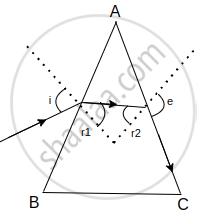
At face AC, let the angle of incidence be r2. For grazing ray, e = 90°
⇒ μ = `1/sinr_2`
⇒ r2 = `sin^-1(1/sqrt(2))` = 45°
Let the angle of refraction at face AB be r1.
Now r1 + r2 = A
∴ r1 = A – r2 = 60º – 45º = 15º
Let the angle of incidence at this face be i
μ = `sini/sin r_1`
⇒ `sqrt(2) = sini/sin15^circ`
∴ i = `sin^-1 (sqrt(2).sin15^circ)` = 21.5º
APPEARS IN
संबंधित प्रश्न
The threshold wavelength of silver is 3800Å. Calculate the maximum kinetic energy in eV of photoelectrons emitted, when ultraviolet light of wavelength 2600Å falls on it.
(Planck’s constant, h =6.63 x 1O-34J.s.,
Velocity of light in air, c = 3 x 10⁸ m / s)
The momentum of a photon of de Broglie wavelength 5000Å is _______.
[Planck’s constant = 6.63 x10⁻³⁴ J.s.]
Einstein's photoelectric equation is:
a) `E_"max" = hlambda - varphi_0`
b) `E_"max"= (hc)/lambda varphi_0`
c) `E_"max" = hv + varphi_0`
d) `E_"max" = (hv)/lambda + varphi_0`
With reference to the photoelectric effect, define threshold wavelength
Plot a labelled graph of |Vs| where Vs is stopping potential versus frequency f of the incident radiation. State how will you use this graph to determine the value of Planck's constant?
Who indirectly determined the mass of the electron by measuring the charge of the electrons?
If the frequency of light in a photoelectric experiment is double the stopping potential will
- Calculate the frequency of a photon of energy 6.5 × 10⁻¹⁹ J.
- Can this photon cause the emission of an electron from the surface of Cs of work function 2.14 eV? If yes, what will be the maximum kinetic energy of the photoelectron?
How does stopping potential in photoelectric emission vary if the intensity of the incident radiation increases?
How does stopping potential in photoelectric emission vary if the frequency of incident radiation decreases?
