Advertisements
Advertisements
Question
Define modulation index.
Advertisements
Solution
The modulation index is defined as the ratio between the amplitude of modulating signal and carrier wave.
APPEARS IN
RELATED QUESTIONS
How are side bands produced?
Why is Modulation index kept low?
A carrier wave of peak voltage 15 V is used to transmit a message signal. Find the peak voltage of the modulating signal in order to have a modulation index of 60%
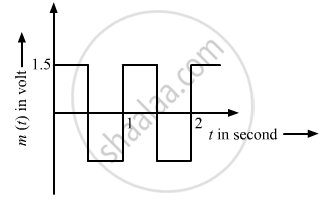
The carrier wave of a signal is given by C(t) = 3 sin (8πt) volt. The modulating signal is a square wave as shown. Find its modulation index.
Broadcasting antennas are generally ______.
A 100 m long antenna is mounted on a 500 m tall building. The complex can become a transmission tower for waves with λ.
A speech signal of 3 kHz is used to modulate a carrier signal of frequency 1 MHz, using amplitude modulation. The frequencies of the sidebands will be ______.
A TV transmission tower antenna is at a height of 20 m. How much service area can it cover if the receiving antenna is (i) at ground level, (ii) at a height of 25 m? Calculate the percentage increase in area covered in case (ii) relative to case (i).
A 25 m long antenna is mounted on an antenna tower. The height of the antenna tower is 75 m. The wavelength (in meter) of the signal transmitted by this antenna would be ______.
A carrier wave Vc(t) = 160 sin(2π × 106t) volts is made to vary between Vmax = 200 V and Vmin = 120 V by a message signal Vm(t) = Am sin(2π × 103t) volts. The peak voltage Am of the modulating signal is ______.
