Advertisements
Advertisements
Question
Define angular dispersion.
Advertisements
Solution
The angular separation between the two extreme colours (violet and red) in the spectrum (which is obtained by passing a beam of white light through a prism) is known as angular dispersion.
APPEARS IN
RELATED QUESTIONS
What is the cause of dispersion of light
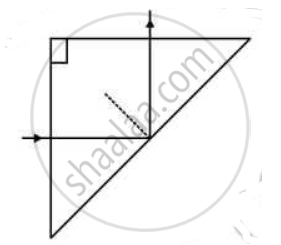
A ray of light incident normally on one face of a right isosceles prism is totally reflected, as shown in fig. What must be the minimum value of refractive index of glass? Give relevant calculations.
State any two difference between the primary rainbow and secondary rainbow
For any prism, prove that :
'n' or `mu = sin((A + delta_m)/2)/sin(A/2)`
where the terms have their usual meaning
Out of blue and red light which is deviated more by a prism? Give reason.
A certain material has refractive indices 1.56, 1.60 and 1.68 rfor red, yellow and violet lightespectively. (a) Calculate the dispersive power. (b) Find the angular dispersion produced by a thin prism of angle 6° made of this material.
Two prisms of identical geometrical shape are combined with their refracting angles oppositely directed. The materials of the prisms have refractive indices 1.52 and 1.62 for violet light. A violet ray is deviated by 1.0° when passes symmetrically through this combination. What is the angle of the prisms?
A narrow beam of monochromatic light, PQ, is incident normally on one face of an equiangular glass prism of refractive index 1.45. When the prism is immersed in a certain liquid, the ray makes a grazing emergence along the other face (See figure). Find the refractive index of this liquid. 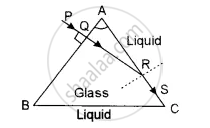
How does the angle of minimum deviation of a glass prism vary if the incident violet light is replaced by red light?
Prove that in case of a prism, i + e = A + δ, where the symbols have their usual meanings.
