Advertisements
Advertisements
Questions
Construct a triangle of sides 4 cm, 5cm and 6cm and then a triangle similar to it whose sides are `2/3` of the corresponding sides of the first triangle. Give the justification of the construction.
Construct a triangle with sides 5 cm, 4 cm and 6 cm. Then construct another triangle whose sides are `2/3` times the corresponding sides of first triangle.
Construct a triangle of sides 4 cm, 5 cm and 6 cm and then a triangle similar to it whose sides are `2/3` of the corresponding sides of it.
Advertisements
Solution
Step 1
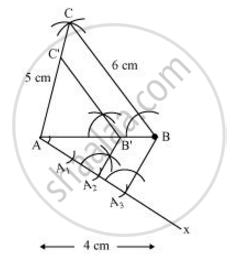
Draw a line segment AB = 4 cm. Taking point A as centre, draw an arc of 5 cm radius. Similarly, taking point B as its centre, draw an arc of 6 cm radius. These arcs will intersect each other at point C. Now, AC = 5 cm and BC = 6 cm and ΔABC is the required triangle.
Step 2
Draw a ray AX making an acute angle with line AB on the opposite side of vertex C.
Step 3
Locate 3 points A1, A2, A3 (as 3 is greater between 2 and 3) on line AX such that AA1 = A1A2 = A2A3.
Step 4
Join BA3 and draw a line through A2 parallel to BA3 to intersect AB at point B'.
Step 5
Draw a line through B' parallel to the line BC to intersect AC at C'.
ΔAB'C' is the required triangle.
Justification
The construction can be justified by proving that
`AB' = 2/3AB, B'C' = 2/3BC, AC' = 2/3 AC`
By construction, we have B’C’ || BC
∴ ∠AB'C'= ∠ABC (Corresponding angles)
In ΔAB'C' and ΔABC,
∠AB'C' = ∠ABC (Proved above)
∠B'AC' = ∠BAC (Proved above)
∴ ΔAB'C' ~ ΔABC (AA similarity criterion)
`=> (AB')/(AB) = (B'C')/(BC) = (AC')/(AC) ....(1)`
In ΔAA2B' and ΔAA3B,
∠A2AB' = ∠A3AB (Common)
∠AA2B' = ∠AA3B (Corresponding angles)
∴ ΔAA2B' ∼ ΔAA3B (AA similarity criterion)
`=> (AB')/(AB) = (`
`=> (AB')/(AB) = 2/3 ....(2)`
From equations (1) and (2), we obtain
`(AB')/(AB) = (B'C')/(BC) = (AC')/(AC) = 2/3`
`=>AB' = 2/3(AB), B'C' = 2/3(BC), AC' = 2/3(AC)`
This justifies the construction.
APPEARS IN
RELATED QUESTIONS
Find the ratio in which the line segment joining the points A(3,- 3) and B(- 2, 7) is divided by x-axis. Also find the coordinates of the point of division.
Construct a triangle ABC with BC = 7 cm, ∠B = 60° and AB = 6 cm. Construct another triangle whose sides are `3/4` times the corresponding sides of ∆ABC.
Draw a line segment of length 7.6 cm and divide it in the ratio 5:8. Measure the two parts. Give the justification of the construction.
Construct an isosceles triangle whose base is 8 cm and altitude 4 cm and then another triangle whose side are `1 1/2` times the corresponding sides of the isosceles triangle.
Give the justification of the construction
Determine a point which divides a line segment of length 12 cm internally in the ratio 2 : 3 Also, justify your construction.
Construct a triangle similar to a given ΔABC such that each of its sides is (2/3)rd of the corresponding sides of ΔABC. It is given that BC = 6 cm, ∠B = 50° and ∠C = 60°.
Draw a ΔABC in which BC = 6 cm, AB = 4 cm and AC = 5 cm. Draw a triangle similar to ΔABC with its sides equal to (3/4)th of the corresponding sides of ΔABC.
Construct a ΔABC in which AB = 5 cm. ∠B = 60° altitude CD = 3cm. Construct a ΔAQR similar to ΔABC such that side ΔAQR is 1.5 times that of the corresponding sides of ΔACB.
Construct an isosceles triangle whose base is 8 cm and altitude 4 cm and then another triangle whose sides are 3/2 times the corresponding sides of the isosceles triangle.
Draw a right triangle in which the sides (other than the hypotenuse) are of lengths 4 cm and 3 cm. Now construct another triangle whose sides are \[\frac{3}{5}\] times the corresponding sides of the given triangle.
Find the co-ordinates of the centroid of the Δ PQR, whose vertices are P(3, –5), Q(4, 3) and R(11, –4)
To divide a line segment AB in the ratio p : q (p, q are positive integers), draw a ray AX so that ∠BAX is an acute angle and then mark points on ray AX at equal distances such that the minimum number of these points is ______.
To divide a line segment AB in the ratio 5 : 7, first a ray AX is drawn so that ∠BAX is an acute angle and then at equal distances points are marked on the ray AX such that the minimum number of these points is ______.
To divide a line segment AB in the ratio 5 : 6, draw a ray AX such that ∠BAX is an acute angle, then draw a ray BY parallel to AX and the points A1, A2, A3, ... and B1, B2, B3, ... are located at equal distances on ray AX and BY, respectively. Then the points joined are ______.
To construct a triangle similar to a given ΔABC with its sides `8/5` of the corresponding sides of ΔABC draw a ray BX such that ∠CBX is an acute angle and X is on the opposite side of A with respect to BC. Then minimum number of points to be located at equal distances on ray BX is ______.
For ∆ABC in which BC = 7.5cm, ∠B =45° and AB - AC = 4, select the correct figure.
To divide a line segment PQ in the ratio 5 : 7, first a ray PX is drawn so that ∠QPX is an acute angle and then at equal distances points are marked on the ray PX such that the minimum number of these points is ______.
If a triangle similar to given ΔABC with sides equal to `3/4` of the sides of ΔABC is to be constructed, then the number of points to be marked on ray BX is ______.
Two line segments AB and AC include an angle of 60° where AB = 5 cm and AC = 7 cm. Locate points P and Q on AB and AC, respectively such that AP = `3/4` AB and AQ = `1/4` AC. Join P and Q and measure the length PQ.
Draw a line segment of length 7 cm and divide it in the ratio 5 : 3.
