Advertisements
Advertisements
प्रश्न
Construct a triangle of sides 4 cm, 5cm and 6cm and then a triangle similar to it whose sides are `2/3` of the corresponding sides of the first triangle. Give the justification of the construction.
Construct a triangle with sides 5 cm, 4 cm and 6 cm. Then construct another triangle whose sides are `2/3` times the corresponding sides of first triangle.
Construct a triangle of sides 4 cm, 5 cm and 6 cm and then a triangle similar to it whose sides are `2/3` of the corresponding sides of it.
Advertisements
उत्तर
Step 1
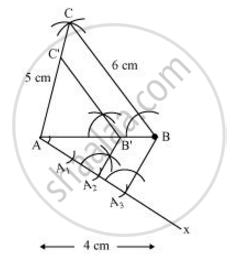
Draw a line segment AB = 4 cm. Taking point A as centre, draw an arc of 5 cm radius. Similarly, taking point B as its centre, draw an arc of 6 cm radius. These arcs will intersect each other at point C. Now, AC = 5 cm and BC = 6 cm and ΔABC is the required triangle.
Step 2
Draw a ray AX making an acute angle with line AB on the opposite side of vertex C.
Step 3
Locate 3 points A1, A2, A3 (as 3 is greater between 2 and 3) on line AX such that AA1 = A1A2 = A2A3.
Step 4
Join BA3 and draw a line through A2 parallel to BA3 to intersect AB at point B'.
Step 5
Draw a line through B' parallel to the line BC to intersect AC at C'.
ΔAB'C' is the required triangle.
Justification
The construction can be justified by proving that
`AB' = 2/3AB, B'C' = 2/3BC, AC' = 2/3 AC`
By construction, we have B’C’ || BC
∴ ∠AB'C'= ∠ABC (Corresponding angles)
In ΔAB'C' and ΔABC,
∠AB'C' = ∠ABC (Proved above)
∠B'AC' = ∠BAC (Proved above)
∴ ΔAB'C' ~ ΔABC (AA similarity criterion)
`=> (AB')/(AB) = (B'C')/(BC) = (AC')/(AC) ....(1)`
In ΔAA2B' and ΔAA3B,
∠A2AB' = ∠A3AB (Common)
∠AA2B' = ∠AA3B (Corresponding angles)
∴ ΔAA2B' ∼ ΔAA3B (AA similarity criterion)
`=> (AB')/(AB) = (`
`=> (AB')/(AB) = 2/3 ....(2)`
From equations (1) and (2), we obtain
`(AB')/(AB) = (B'C')/(BC) = (AC')/(AC) = 2/3`
`=>AB' = 2/3(AB), B'C' = 2/3(BC), AC' = 2/3(AC)`
This justifies the construction.
APPEARS IN
संबंधित प्रश्न
Draw a triangle ABC with side BC = 7 cm, ∠B = 45°, ∠A = 105°. Then, construct a triangle whose sides are `4/3 `times the corresponding side of ΔABC. Give the justification of the construction.
Draw a line segment of length 7 cm and divide it internally in the ratio 2 : 3.
Draw a right triangle in which the sides (other than the hypotenuse) are of lengths 4 cm and 3 cm. Now construct another triangle whose sides are `3/5` times the corresponding sides of the given triangle.
Construct a triangle similar to a given ΔABC such that each of its sides is (5/7)th of the corresponding sides of Δ ABC. It is given that AB = 5 cm, BC = 7 cm and ∠ABC = 50°.
Construct a triangle similar to a given ΔXYZ with its sides equal to (3/4)th of the corresponding sides of ΔXYZ. Write the steps of construction.
Draw a triangle ABC with side BC = 6 cm, ∠C = 30° and ∠A = 105°. Then construct another triangle whose sides are `2/3` times the corresponding sides of ΔABC.
∆PQR ~ ∆LTR. In ∆PQR, PQ = 4.2 cm, QR = 5.4 cm, PR = 4.8 cm. Construct ∆PQR and ∆LTR, such that `"PQ"/"LT" = 3/4`.
If A (20, 10), B(0, 20) are given, find the coordinates of the points which divide segment AB into five congruent parts.
Draw seg AB of length 9.7 cm. Take a point P on it such that A-P-B, AP = 3.5 cm. Construct a line MN ⊥ sag AB through point P.
______ number of tangents can be drawn to a circle from the point on the circle.
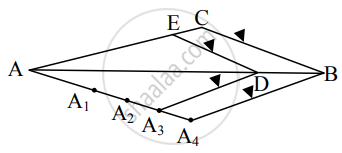
In the figure ΔABC ~ ΔADE then the ratio of their corresponding sides is:
Construct an equilateral ∆ABC with side 5 cm. ∆ABC ~ ∆LMN, ratio the corresponding sides of triangle is 6 : 7, then construct ΔLMN and ΔABC.
To construct a triangle similar to a given ΔABC with its sides `3/7` of the corresponding sides of ΔABC, first draw a ray BX such that ∠CBX is an acute angle and X lies on the opposite side of A with respect to BC. Then locate points B1, B2, B3, ... on BX at equal distances and next step is to join ______.
For ∆ABC in which BC = 7.5cm, ∠B =45° and AB - AC = 4, select the correct figure.
The point W divides the line XY in the ratio m : n. Then, the ratio of lengths of the line segments XY : WX is ______.
What is the ratio `(AC)/(BC)` for the following construction: A line segment AB is drawn. A single ray is extended from A and 12 arcs of equal lengths are cut, cutting the ray at A1, A2… A12.A line is drawn from A12 to B and a line parallel to A12B is drawn, passing through the point A6 and cutting AB at C.
By geometrical construction, it is possible to divide a line segment in the ratio `sqrt(3) : 1/sqrt(3)`.
Draw a line segment of length 7.5 cm and divide it in the ratio 1:3.
