Advertisements
Advertisements
प्रश्न
∆PQR ~ ∆LTR. In ∆PQR, PQ = 4.2 cm, QR = 5.4 cm, PR = 4.8 cm. Construct ∆PQR and ∆LTR, such that `"PQ"/"LT" = 3/4`.
Advertisements
उत्तर
Rough figure:
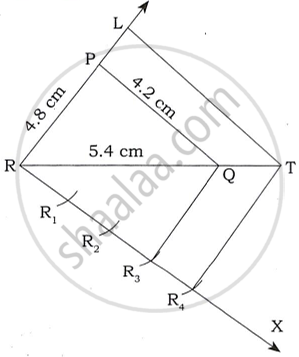
Steps of construction:
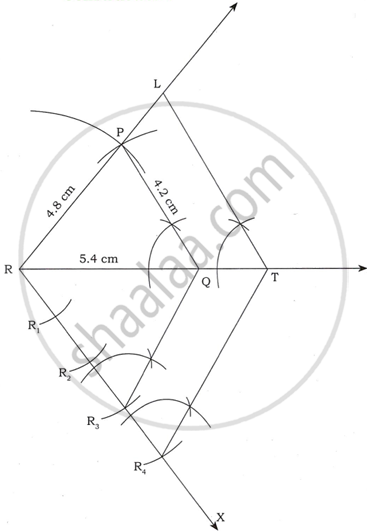
- Draw ΔPQR such that PQ = 4.2 cm, QR = 5.4 cm and PR = 4.8 cm.
- Draw a ray at point R, making a suitable angle with seg RQ.
- Take equal parts RR1, R1R2, R2R3, R3R4 on ray RX.
- Join the points Q and R3.
- Draw seg TR4 || seg QR3.
- Draw seg LT || seg PQ.
Construction:
Notes
- For drawing ΔPRQ of given measures = 1 mark
- For drawing acute angle at point R = 0.5 mark
- To mark points R1, R2, R3, R4 on ray RX at equal distance from point R = 0.5 mark
- To join seg R3Q and to draw parallel seg R4T to seg R3Q = 0.5 mark
- To draw parallel seg to PQ at point T = 0.5 mark
APPEARS IN
संबंधित प्रश्न
Construct a triangle ABC with BC = 7 cm, ∠B = 60° and AB = 6 cm. Construct another triangle whose sides are `3/4` times the corresponding sides of ∆ABC.
Draw a line segment of length 7.6 cm and divide it in the ratio 5:8. Measure the two parts. Give the justification of the construction.
Construct a triangle of sides 4 cm, 5cm and 6cm and then a triangle similar to it whose sides are `2/3` of the corresponding sides of the first triangle. Give the justification of the construction.
Determine a point which divides a line segment of length 12 cm internally in the ratio 2 : 3 Also, justify your construction.
Divide a line segment of length 14 cm internally in the ratio 2 : 5. Also, justify your construction.
Construct an isosceles triangle whose base is 8 cm and altitude 4 cm and then another triangle whose sides are 3/2 times the corresponding sides of the isosceles triangle.
Construct a triangle similar to a given ΔXYZ with its sides equal to (3/4)th of the corresponding sides of ΔXYZ. Write the steps of construction.
Construct a right triangle in which the sides, (other than the hypotenuse) are of length 6 cm and 8 cm. Then construct another triangle, whose sides are `3/5` times the corresponding sides of the given triangle.
∆ABC ~ ∆LBN. In ∆ABC, AB = 5.1 cm, ∠B = 40°, BC = 4.8 cm, \[\frac{AC}{LN} = \frac{4}{7}\]. Construct ∆ABC and ∆LBN.
Construct ∆PYQ such that, PY = 6.3 cm, YQ = 7.2 cm, PQ = 5.8 cm. If \[\frac{YZ}{YQ} = \frac{6}{5},\] then construct ∆XYZ similar to ∆PYQ.
Find the ratio in which point T(–1, 6)divides the line segment joining the points P(–3, 10) and Q(6, –8).
______ number of tangents can be drawn to a circle from the point on the circle.
Draw seg AB of length 9 cm and divide it in the ratio 3 : 2.
ΔPQR ~ ΔABC. In ΔPQR, PQ = 3.6 cm, QR = 4 cm, PR = 4.2 cm. Ratio of the corresponding sides of triangle is 3 : 4, then construct ΔPQR and ΔABC.
To construct a triangle similar to a given ΔABC with its sides `8/5` of the corresponding sides of ΔABC draw a ray BX such that ∠CBX is an acute angle and X is on the opposite side of A with respect to BC. Then minimum number of points to be located at equal distances on ray BX is ______.
For ∆ABC in which BC = 7.5cm, ∠B =45° and AB - AC = 4, select the correct figure.
When a line segment is divided in the ratio 2 : 3, how many parts is it divided into?
The ratio of corresponding sides for the pair of triangles whose construction is given as follows: Triangle ABC of dimensions AB = 4cm, BC = 5 cm and ∠B= 60°.A ray BX is drawn from B making an acute angle with AB.5 points B1, B2, B3, B4 and B5 are located on the ray such that BB1 = B1B2 = B2B3 = B3B4 = B4B5.
B4 is joined to A and a line parallel to B4A is drawn through B5 to intersect the extended line AB at A’.
Another line is drawn through A’ parallel to AC, intersecting the extended line BC at C’. Find the ratio of the corresponding sides of ΔABC and ΔA′BC′.
By geometrical construction, it is possible to divide a line segment in the ratio `sqrt(3) : 1/sqrt(3)`.
Draw a line segment of length 7 cm and divide it in the ratio 5 : 3.
