Advertisements
Advertisements
Question
Construct an equilateral triangle with each side 6 cm. In the triangle drawn, draw all the possible lines of symmetry.
Advertisements
Solution
Steps of Construction:
(i) Draw a line segment BC = 6 cm

(ii) With centres B and C and radius 6 cm, draw two arcs intersecting each other at A.
(iii) Join AB and AC
∆ ABC is the required equilateral triangle,
(iv) Draw the angle bisectors of ∠A, ∠B, and ∠C.
These are the lines of symmetry which are three in numbers as the triangle is equilateral.
APPEARS IN
RELATED QUESTIONS
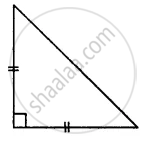
In the figure given below, draw the line (s) of symmetry, if possible:
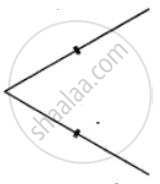
In the figure given below, draw the line (s) of symmetry, if possible:
Draw a quadrilateral with exactly two lines of symmetry. In case, if possible, represent the line/ lines of symmetry by dotted lines. Also, write the special name of the quadrilateral drawn.
In each of the figure below, state the number of axes of symmetry, if any.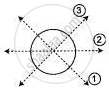
Write the capital letters of the English alphabet in your notebook. Try to draw their axes of symmetry. Which ones have an axis of symmetry? Which ones have more than one axis of symmetry?
One day his clever daughter gave him an idea which he liked very much. Now he never got confused.
- Can you guess what the idea was?

Give half a turn to the numbers from 0 to 9. Find which of them still looks the same.
Identify the shape given below. Check whether they are symmetric or not. Draw the line of symmetry as well.
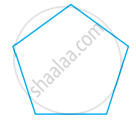
A circle has two lines of symmetry.
Draw all lines of symmetry for the following figure.