Advertisements
Advertisements
Question
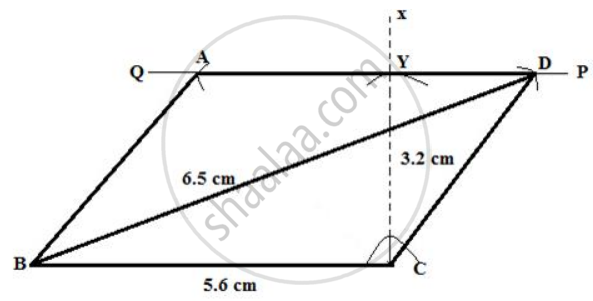
Construct a parallelogram ABCD, when:
Base BC = 5.6 cm, diagonal BD = 6.5 cm and altitude = 3.2 cm.
Advertisements
Solution
Steps:
1. Draw BC = 5.6 cm.
2. At C, draw CX perpendicular to BC.
3. with C as a centre and taking radius 3.2 cm to draw an arc to cut CX at Y.
4. Through Y draw a straight line PQ parallel to BC.
5. With B as a centre and radius, 6.5 cm draw an arc to meet PQ at D.
6. With D as a centre and radius equal to 5.6 cm, draw an arc to meet PQ at A.
7. Join BA, BD and CD.
ABCD is the required parallelogram.
APPEARS IN
RELATED QUESTIONS
Draw parallelogram ABCD with the following data:
AB = 6 cm, AD = 5 cm and ∠DAB = 45o.
Let AC and DB meet in O and let E be the mid-point of BC. Join OE.
Prove that:
(i) OE // AB
(ii) OE = `1/2` AB.
The perpendicular distance between the pair of opposite sides of a parallelogram are 3 cm and 4 cm, and one of its angles measures 60o. Using a ruler and compasses only,
construct the parallelogram.
Construct a parallelogram ABCD, when:
AB = 5.8 cm, diagonal AC = 8.2 cm and diagonal BD = 6.2 cm.
Construct a parallelogram ABCD, when:
AB = 6.0 cm, AD = 5.0 cm and ∠A = 45°.
Construct a parallelogram ABCD, if :
AB = 3.6 cm, BC = 4.5 cm and ∠ABC = 120°.
Construct a parallelogram ABCD, if :
AD = 4 cm, DC = 5 cm and diagonal BD = 7 cm.
Construct a parallelogram ABCD, if :
AB = 5.8 cm, AD = 4.6 cm and diagonal AC = 7.5 cm.
Construct a parallelogram ABCD, if :
diagonal AC = 6.4 cm, diagonal BD = 5.6 cm and angle between the diagonals is 75°.
Construct a parallelogram ABCD. Given:
AB = 5.5cm, BC = 3.5cm, ∠B = 75°
Construct a parallelogram PQRS in which PQ = 6.4cm, QR = 4cm and the distance between PQ and SR is 3cm.