Advertisements
Advertisements
Question
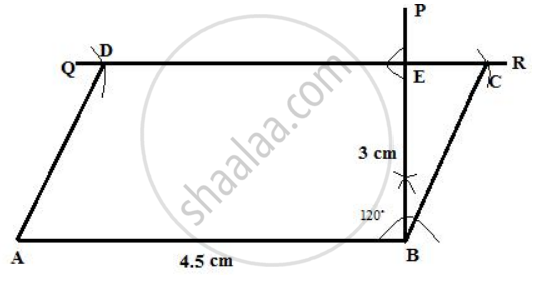
Construct a parallelogram ABCD, when:
AB = 4.5 cm, ∠B = 120° and the distance between AB and DC = 3.0 cm.
Advertisements
Solution

Steps:
- Draw AB = 4.5 cm.
- At B, draw BP ⊥ AB.
- From BP cut BE = 3 cm.
- Through E, draw a perpendicular to BP to get QR parallel to AB.
- Draw BP, such that ∠B = 120°.
- Let BP intersect QR at C.
- With A as center and radius = BC, draw an arc cutting QR at D.
- Join AD, BC and CD.
ABCD is the required parallelogram.
APPEARS IN
RELATED QUESTIONS
Draw parallelogram ABCD with the following data:
AB = 6 cm, AD = 5 cm and ∠DAB = 45o.
Let AC and DB meet in O and let E be the mid-point of BC. Join OE.
Prove that:
(i) OE // AB
(ii) OE = `1/2` AB.
The perpendicular distance between the pair of opposite sides of a parallelogram are 3 cm and 4 cm, and one of its angles measures 60o. Using a ruler and compasses only,
construct the parallelogram.
Construct a parallelogram ABCD, when:
AB = 5.8 cm, diagonal AC = 8.2 cm and diagonal BD = 6.2 cm.
Construct a parallelogram ABCD, when:
Base AB = 6.5 cm, BC = 4 cm and the altitude corresponding to AB = 3.1 cm.
Construct a parallelogram ABCD, when:
Base BC = 5.6 cm, diagonal BD = 6.5 cm and altitude = 3.2 cm.
Construct a parallelogram ABCD, if :
AB = 5.8 cm, AD = 4.6 cm and diagonal AC = 7.5 cm.
Construct a parallelogram ABCD, if :
lengths of diagonals AC and BD are 6.3 cm and 7.0 cm respectively, and the angle between them is 45°.
Construct a parallelogram ABCD, if :
lengths of diagonals AC and BD are 5.4 cm and 6.7 cm respectively and the angle between them is 60°.
Draw a parallelogram ABCD, with AB = 6 cm, AD = 4.8 cm and ∠DAB = 45°. Draw the perpendicular bisector of side AD and let it meet AD at point P. Also, draw the diagonals AC and BD; and let them intersect at point O. Join O and P. Measure OP.
Construct a parallelogram ABCD. Given:
AB = 5.5cm, BC = 3.5cm, ∠B = 75°