Advertisements
Advertisements
Question
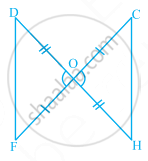
Consider the given pairs of triangles and say whether each pair is that of congruent triangles. If the triangles are congruent, say ‘how’; if they are not congruent say ‘why’ and also say if a small modification would make them congruent: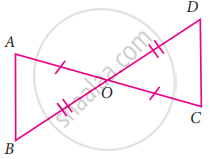
Advertisements
Solution
In the given figure AC and BD bisect each other at O.
∴ OA = OC ...(Given), OB = OD ...(Given)
∠AOB = ∠COD ...(vertically opposite angles)
By SAS congruency
ΔAOB ≅ ΔOCD
APPEARS IN
RELATED QUESTIONS
Given below are measurements of some parts of two triangles. Examine whether the two triangles are congruent or not, by using the SAS congruence rule. If the triangles are congruent, write them in symbolic form.
∆ABC, AB = 7 cm, BC = 5 cm, ∠B = 50°.
∆DEF, DE = 5 cm, EF = 7 cm, ∠E = 50°.
In the given figure, ΔBCD is isosceles with base BD and ∠BAE ≡∠DEA. Prove that AB ≡ ED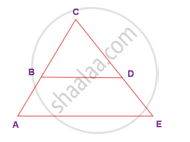
In the figure, given that ∠1 = ∠2 and ∠3 ≡ ∠4. Prove that ∆MUG ≡ ∆TUB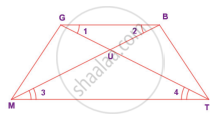
Construct a triangle ABC with given conditions.
AB = 7 cm, AC = 6.5 cm and ∠A = 120°
Construct a triangle XYZ with the given conditions.
BC = 8 cm, AC = 6 cm and ∠C = 40°
In the following figure, M is the mid-point of both AC and BD. Then ______.
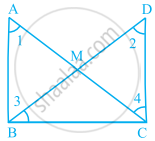
In the following figure, which pairs of triangles are congruent by SAS congruence criterion (condition)? if congruent, write the congruence of the two triangles in symbolic form.
State which of the following pairs of triangles are congruent. If yes, write them in symbolic form (you may draw a rough figure).
∆PQR: PQ = 3.5 cm, QR = 4.0 cm, ∠Q = 60°
∆STU: ST = 3.5 cm, TU = 4 cm, ∠T = 60°
State which of the following pairs of triangles are congruent. If yes, write them in symbolic form (you may draw a rough figure).
∆ABC: AB = 4.8 cm, ∠A = 90°, AC = 6.8 cm
∆XYZ: YZ = 6.8 cm, ∠X = 90°, ZX = 4.8 cm
In the following figure, PQ = PS and ∠1 = ∠2.
- Is ∆PQR ≅ ∆PSR? Give reasons.
- Is QR = SR? Give reasons.

