Advertisements
Advertisements
Question
Construct a triangle ABC with given conditions.
AB = 7 cm, AC = 6.5 cm and ∠A = 120°
Advertisements
Solution
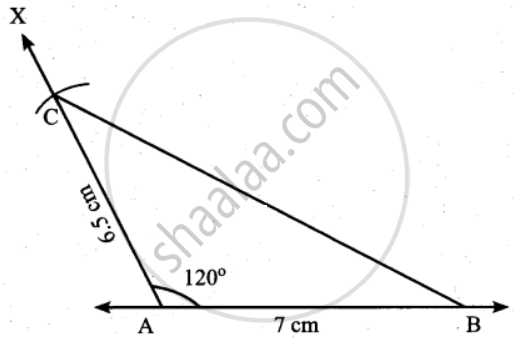

Construction:
Step 1: Drawn a line. Marked A and B on the line such that AB = 7 cm.
Step 2: At A, drawn a ray AX making an angle of 120° with AB.
Step 3: With A as centre, drawn an arc of radius 6.5 cm to cut the ray AX.
Marked the point of intersection as C.
Step 4: Joined BC.
ABC is the required triangle.
APPEARS IN
RELATED QUESTIONS
To conclude the congruency of triangles, mark the required information in the following figure with reference to the given congruency criterion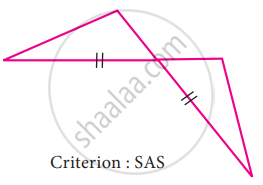
Construct a triangle XYZ with the given conditions.
BC = 8 cm, AC = 6 cm and ∠C = 40°
Using the given figure, prove that the triangles are congruent. Can you conclude that AC is parallel to DE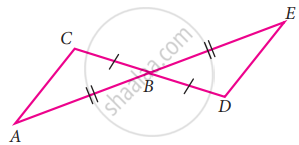
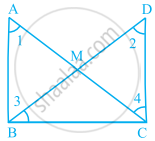
In the following figure, M is the mid-point of both AC and BD. Then ______.
In the following figure, ∆PQR ≅ ∆ ______.
In the following figure, two triangles are congruent by RHS.

In the following figure, which pairs of triangles are congruent by SAS congruence criterion (condition)? if congruent, write the congruence of the two triangles in symbolic form.

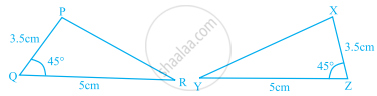
In the following figure, which pairs of triangles are congruent by SAS congruence criterion (condition)? if congruent, write the congruence of the two triangles in symbolic form.

In the following figure, which pairs of triangles are congruent by SAS congruence criterion (condition)? if congruent, write the congruence of the two triangles in symbolic form.

In the following figure, DE = IH, EG = FI and ∠E = ∠I. Is ∆DEF ≅ ∆HIG? If yes, by which congruence criterion?

