Advertisements
Advertisements
Question
Consider the given pairs of triangles and say whether each pair is that of congruent triangles. If the triangles are congruent, say ‘how’; if they are not congruent say ‘why’ and also say if a small modification would make them congruent: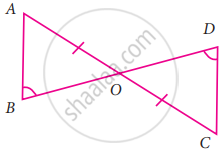
Advertisements
Solution
In the given figure BD bisect AC
In ΔAOB and ΔOCD
OA = OC ...(Given)
∠AOB = ∠DOC ...(vertically opposite angles)
∠B = ∠D ...(Given)
By ASA congruency
ΔAOB ≅ ΔOCD
APPEARS IN
RELATED QUESTIONS
State whether the two triangles are congruent or not. Justify your answer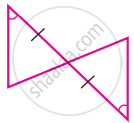
To conclude the congruency of triangles, mark the required information in the following figure with reference to the given congruency criterion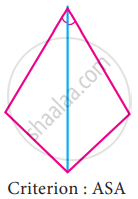
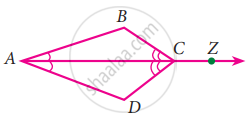
In the given figure ray AZ bisects ∠BAD and ∠DCB, prove that ∆BAC ≅ ∆DAC
Two triangles are congruent, if two angles and the side included between them in one of the triangles are equal to the two angles and the side included between them of the other triangle. This is known as the ______.
AAS congruence criterion is same as ASA congruence criterion.
In the following figure, AD ⊥ BC and AD is the bisector of angle BAC. Then, ∆ABD ≅ ∆ACD by RHS.

In the given pairs of triangles of figure, applying only ASA congruence criterion, determine which triangles are congruent. Also, write the congruent triangles in symbolic form.

In the given pairs of triangles of figure, applying only ASA congruence criterion, determine which triangles are congruent. Also, write the congruent triangles in symbolic form.

In the given pairs of triangles of figure, applying only ASA congruence criterion, determine which triangles are congruent. Also, write the congruent triangles in symbolic form.

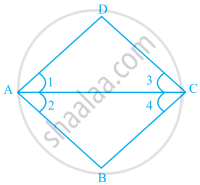
In the following figure, ∠1 = ∠2 and ∠3 = ∠4.
- Is ∆ADC ≅ ∆ABC? Why ?
- Show that AD = AB and CD = CB.