Advertisements
Advertisements
Question
Consider a point at the focal point of a convergent lens. Another convergent lens of short focal length is placed on the other side. What is the nature of the wavefronts emerging from the final image?
Advertisements
Solution
Orientation of wavefront is perpendicular to ray. The ray diagram of the situation is shown in figure.

Parallel rays incident on lens L1 forms the image I2 at the focal point of the lens. This image acts as object for the lens L2 Now, due to the converging lens L2 , let final image formed is I which is point image. Hence the wavefront for this image will be of spherical symmetry.
APPEARS IN
RELATED QUESTIONS
On the basis of Huygens' wave theory of light prove that velocity of light in a rarer medium is greater than velocity of light in a denser medium.
Explain the construction of plane wavefront using Huygens’ principle.
What is the shape of the wavefront in the following case?
Light diverging from a point source.
What is the shape of the wavefront in the following case?
Light emerging out of a convex lens when a point source is placed at its focus.
What is the shape of the wavefront in the following case?
The portion of the wavefront of light from a distant star was intercepted by the Earth.
The refractive indices of water and diamond are `4/3` and 2.42 respectively. Find the speed of light in water and diamond. (c = 3x10⁸ m/s)
When the width of the slit is made double the original width, how would this affect the size and intensity of the central diffraction band?
State Huygens’s principle. Show, with the help of a suitable diagram, how this principle is used to obtain the diffraction pattern by a single slit.
Draw a plot of intensity distribution and explain clearly why the secondary maxima becomes weaker with increasing order (n) of the secondary maxima.
Light waves travel in vacuum along the X-axis. Which of the following may represent the wave fronts?
With what type of source of light are cylindrical wave fronts associated?
Answer the following question.
Define the term wavefront. Using Huygen's wave theory, verify the law of reflection.
Define a wavefront. Using 'Huygens' principle, draw the shape of a refracted wavefront, when a plane wave is incident on a convex lens.
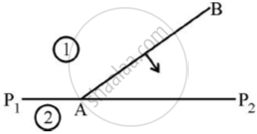
A plane wave front AB propagating from denser medium (1) into a rarer medium (2) is incident on the surface P1P2 separating the two media as shown in fig.
Using Huygen’s principle, draw the secondary wavelets and obtain the refracted wave front in the diagram.
Relation between ray and wavefront is ______.
Answer the following question briefly and to the point:
What is the phase difference between any two points lying on the same wavefront?
Huygen's conception of secondary waves ______.
What type of wavefronts are associated with a source infinity?
Represent diagrammatically how the incident planar wavefronts of wavelength λ pass through an aperture of size d, when d is approximately equal to λ.
