Advertisements
Advertisements
Question
Complete the following table:
| Point | Reflection in | ||
| x-axis | y-axis | origin | |
| (i) (8, 2) | |||
| (ii) (5, 6) | |||
| (iii) (4, −5) | |||
| (iv) (6, −2) | |||
| (v) (−3, 7) | |||
| (vi) (−4, 5) | |||
| (vii) (−2, −7) | |||
| (viii) (−6, −3) | |||
| (ix) (4, 0) | |||
| (x) (−7, 0) | |||
| (xi) (0, −6) | |||
| (xii) (0, 7) | |||
| (xiii) (0, 0) | |||
Advertisements
Solution
| Point | Reflection in | ||
| x-axis | y-axis | origin | |
| (i) (8, 2) | (8, − 2) | (− 8, 2) | (− 8, − 2) |
| (ii) (5, 6) | (5, − 6) | (− 5, 6) | (− 5, − 6) |
| (iii) (4, − 5) | (4, 5) | (− 4, − 5) | (− 4, 5) |
| (iv) (6, − 2) | (6, 2) | (− 6, − 2) | (− 6, 2) |
| (v) (− 3, 7) | (− 3, − 7) | (3, 7) | (3, − 7) |
| (vi) (− 4, 5) | (− 4, − 5) | (4, 5) | (4, − 5) |
| (vii) (− 2, −7 ) | (− 2, 7) | (2, − 7) | (2, 7) |
| (viii) (− 6, − 3) | (− 6, 3) | (6, − 3) | (6, 3) |
| (ix) (4, 0) | (4, 0) | (− 4, 0) | (− 4, 0) |
| (x) (− 7, 0) | (− 7, 0) | (7, 0) | (7, 0) |
| (xi) (0, − 6) | (0, 6) | (0, − 6) | (0, 6) |
| (xii) (0, 7) | (0, − 8) | (0, − 8) | (0, − 8) |
| (xiii) (0, 0) | (0, 0) | (0, 0) | (0, 0) |
APPEARS IN
RELATED QUESTIONS
Mark points A (– 6, 5) and B (– 4, – 6) on a graph paper. Find A’, the image of A in origin and B’, the image of B in origin. Mark A’ and B’ also on the same graph paper. Join AB and A’ B’. Is AB = A’ B’?
Examine the following figure carefully, draw line(s) of symmetry in whichever figure possible:
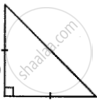
Construct a triangle XYZ, in which XY = YZ = ZX = 4.5 cm. Draw all its lines of symmetry.
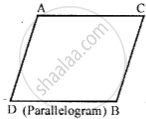
Draw all the possible lines of symmetry for the given figure below:
Use colour, a thread and a folded paper to draw symmetrical shapes.
Observe various commonly seen objects such as tree leaves, birds in flight, pictures of historical buildings, etc. Find symmetrical shapes among them and make a collection of them.
A shape has reflection symmetry if it has a line of symmetry
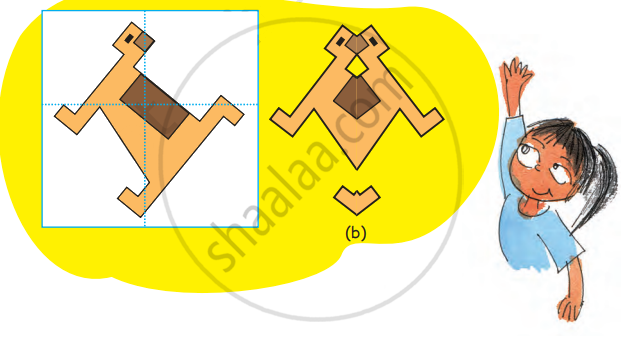
Look at the figure in the white box. On which of the dotted lines will you keep the mirror so that you get shape (b)? Also, tell which part of the picture will be hidden when we keep the mirror on the dotted line.
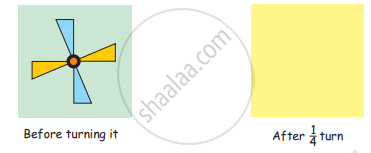
Will this fan also look the same after the `1/4` turn? Draw in the yellow box
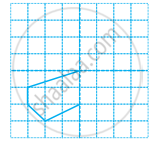
Copy the following drawing on squared paper. Complete such that the resulting figure has two dotted lines as two lines of symmetry.
How did you go about completing the picture?