Advertisements
Advertisements
प्रश्न
Complete the following table:
| Point | Reflection in | ||
| x-axis | y-axis | origin | |
| (i) (8, 2) | |||
| (ii) (5, 6) | |||
| (iii) (4, −5) | |||
| (iv) (6, −2) | |||
| (v) (−3, 7) | |||
| (vi) (−4, 5) | |||
| (vii) (−2, −7) | |||
| (viii) (−6, −3) | |||
| (ix) (4, 0) | |||
| (x) (−7, 0) | |||
| (xi) (0, −6) | |||
| (xii) (0, 7) | |||
| (xiii) (0, 0) | |||
Advertisements
उत्तर
| Point | Reflection in | ||
| x-axis | y-axis | origin | |
| (i) (8, 2) | (8, − 2) | (− 8, 2) | (− 8, − 2) |
| (ii) (5, 6) | (5, − 6) | (− 5, 6) | (− 5, − 6) |
| (iii) (4, − 5) | (4, 5) | (− 4, − 5) | (− 4, 5) |
| (iv) (6, − 2) | (6, 2) | (− 6, − 2) | (− 6, 2) |
| (v) (− 3, 7) | (− 3, − 7) | (3, 7) | (3, − 7) |
| (vi) (− 4, 5) | (− 4, − 5) | (4, 5) | (4, − 5) |
| (vii) (− 2, −7 ) | (− 2, 7) | (2, − 7) | (2, 7) |
| (viii) (− 6, − 3) | (− 6, 3) | (6, − 3) | (6, 3) |
| (ix) (4, 0) | (4, 0) | (− 4, 0) | (− 4, 0) |
| (x) (− 7, 0) | (− 7, 0) | (7, 0) | (7, 0) |
| (xi) (0, − 6) | (0, 6) | (0, − 6) | (0, 6) |
| (xii) (0, 7) | (0, − 8) | (0, − 8) | (0, − 8) |
| (xiii) (0, 0) | (0, 0) | (0, 0) | (0, 0) |
APPEARS IN
संबंधित प्रश्न
Each of the points A (3, 0), B (7, 0), C (- 8, 0), D (- 7, 0) and E (0, 0) is reflected in x-axis to points A’, B’, C’, D’ and E’ respectively. Write the co-ordinates of each of the image points A’, B’, C’, D’ and E’.
Draw the line(s) of symmetry for the figure drawn below:
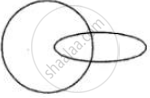
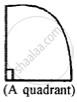
Draw all the possible lines of symmetry for the given figure below:
Observe various commonly seen objects such as tree leaves, birds in flight, pictures of historical buildings, etc. Find symmetrical shapes among them and make a collection of them.
A shape has reflection symmetry if it has a line of symmetry
The three digit number 101 has rotational and reflection symmetry. Give five more examples of three digit numbers which have both rotational and reflection symmetry
Draw the following:
A figure which has both reflection and rotational symmetry
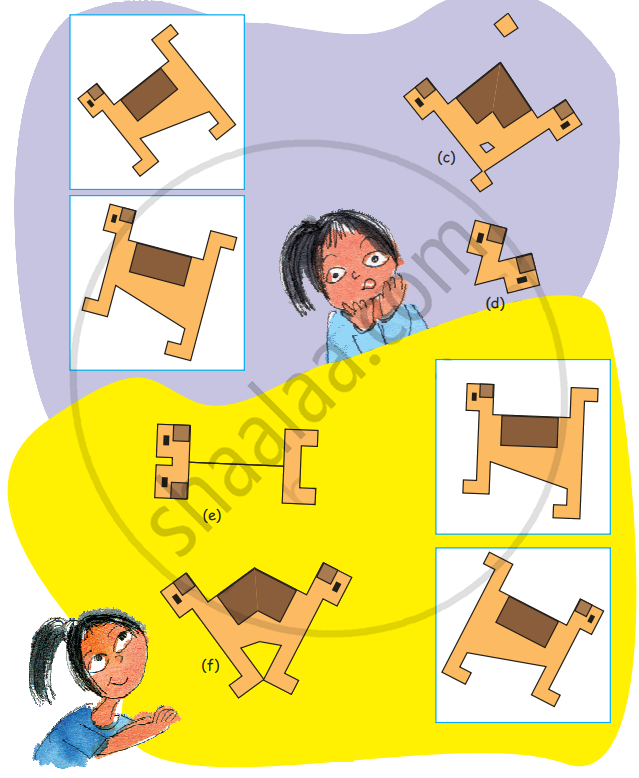
Now make a line on the white box to show where you will keep the Mirror Games mirror to get the picture next to it.
If a line segment of length 5 cm is reflected in a line of symmetry (mirror), then its reflection (image) is a ______ of length _______.
Find the number of lines of symmetry in the following shapes. How will you check your answers?