Advertisements
Advertisements
Question
Cells of this tissue are living and show angular wall thickening. They also provide mechanical support. The tissue is ______.
Options
Xylem
Sclerenchyma
Collenchyma
Epidermis
Advertisements
Solution
Cells of this tissue are living and show angular wall thickening. They also provide mechanical support. The tissue is collenchyma.
Explanation:
Collenchyma is the only tissue which is living and shows angular wall thickening. Cells of the xylem and sclerenchyma are dead cells. Cells of the epidermis do not show wall thickening.
APPEARS IN
RELATED QUESTIONS
Which tissue makes up the husk of coconut?
Name the tissue that transports food in plants.
What is the role of epidermis in plants?
Complete the following chart:

What are simple tissues?
Draw a well-labelled diagram of phloem.
What is the difference between parenchyma and collenchyma?
What is the differences between collenchyma and sclerenchyma?
Explain how sieve tubes manage to be living?
Study the diagram given below and then answer the question that follows:
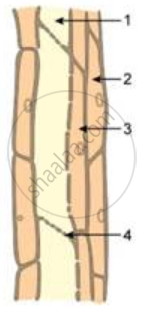
Where is this tissue likely to be found in the plant?
Give the structure and function of the following:
Sclerenchyma
Name the tissue associated with the following:
Movement of food in the plant body
Write 'True or False' for the following statement:
Sclerenchyma cells have intercellular spaces.
Write 'True or False' for the following statement:
A tracheid is longer than a vessel.
The question has four answers. Choose the correct answer:
Hard lignified thick walled, long and pointed cells in a plant are
The question has four answers. Choose the correct answer:
Phloem parenchyma, sclerenchyma, sieve tubes, and companion cells are found in
Choose the correct option.
Collenchyma is a type of ______ tissue.
Differentiate between Xylem and Phloem functioning
Explain sclereids with their types.
