Advertisements
Advertisements
प्रश्न
Cells of this tissue are living and show angular wall thickening. They also provide mechanical support. The tissue is ______.
विकल्प
Xylem
Sclerenchyma
Collenchyma
Epidermis
Advertisements
उत्तर
Cells of this tissue are living and show angular wall thickening. They also provide mechanical support. The tissue is collenchyma.
Explanation:
Collenchyma is the only tissue which is living and shows angular wall thickening. Cells of the xylem and sclerenchyma are dead cells. Cells of the epidermis do not show wall thickening.
APPEARS IN
संबंधित प्रश्न
What are the functions of the stomata?
How does the cork act as a protective tissue?
Complete the following chart:

What are simple tissues? Explain their three different types.
Draw a well labelled diagram of parenchyma and collenchyma.
Give two functions of collenchyma.
Write a short note on sclerenchyma.
Explain different types of elements present in phloem.
What is the difference between parenchyma and collenchyma?
What are the functions of phloem?
What is simple tissue? Classify and explain its different types with suitable diagram.
What is simple tissue? Classify and explain its different types with suitable diagram.
Parenchyma containing chloroplasts is known as :
Name one place in a living organism where the following tissues are located:
Sclerenchyma
Study the diagram given below and then answer the question that follows:
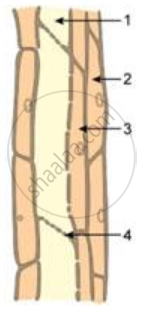
State the function of the parts labelled 1, 2, 3 and 4.
Write 'True or False' for the following statement:
A vascular bundle conducts prepared food only.
Write a short note on peculiarity of a sclerenchyma cell wall.
Name any two simple and two complex permanent tissues in plants.
Fibers are extensively longer ranging from 20 mm to 550 mm ______.
In which of the following pairs of parts of a flowering plant is epidermis absent?
