Advertisements
Advertisements
प्रश्न
Study the diagram given below and then answer the question that follows:
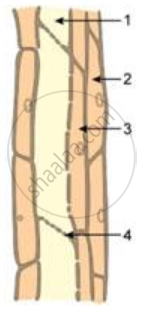
State the function of the parts labelled 1, 2, 3 and 4.
Advertisements
उत्तर
1 → Sieve cells: Help in the transport of food from leaves to storage organs and other parts of the plant.
2 → Phloem parenchyma cells: Storage of starch, fat and other organic food material.
3 → Companion cells: Help in the functioning of the sieve tube cells.
4 → Sieve plate: Perforations in the sieve plates allow water and dissolved organic solutes to flow along the sieve tube.
APPEARS IN
संबंधित प्रश्न
Which tissue makes up the husk of coconut?
Why are xylem and phloem called complex tissues?
Name the different types of elements found in the xylem.
The question has four answers. Choose the correct answer:
Hard lignified thick walled, long and pointed cells in a plant are
Write a short note on peculiarity of a sclerenchyma cell wall.
What are sieve tubes? Explain.
While doing work and running, you move your organs like hands, legs, etc. Which among the following is correct?
The cells or tissues of plants which have lost the power of division are called
Which of the following is a permanent tissue?
In which of the following pairs of parts of a flowering plant is epidermis absent?
