Advertisements
Advertisements
प्रश्न
Study the diagram given below and then answer the question that follows:
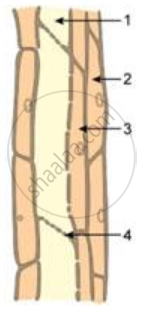
State the function of the parts labelled 1, 2, 3 and 4.
Advertisements
उत्तर
1 → Sieve cells: Help in the transport of food from leaves to storage organs and other parts of the plant.
2 → Phloem parenchyma cells: Storage of starch, fat and other organic food material.
3 → Companion cells: Help in the functioning of the sieve tube cells.
4 → Sieve plate: Perforations in the sieve plates allow water and dissolved organic solutes to flow along the sieve tube.
APPEARS IN
संबंधित प्रश्न
What are tracheary elements?
What is the difference between parenchyma and collenchyma?
What do you know about complex tissue? Classify and explain its different types in plants with suitable diagrams.
Differentiate between cells of Parenchyma and Collenchyma.
Study the diagram given below and then answer the question that follows:
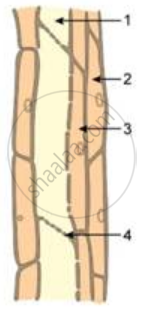
Name the parts labelled 1, 2, 3 and 4.
Give the structure and function of the following:
Sclerenchyma
Write 'True or False' for the following statement:
A vascular bundle conducts prepared food only.
The question has four answers. Choose the correct answer:
Hard lignified thick walled, long and pointed cells in a plant are
Write a short note on peculiarity of a sclerenchyma cell wall.
Explain sclereids with their types.
