Advertisements
Advertisements
Question
Both x and y vary inversely with each other. When x is 10, y is 6, which of the following is not a possible pair of corresponding values of x and y?
Options
12 and 5
15 and 4
25 and 2.4
45 and 1.3
Advertisements
Solution
45 and 1.3
Explanation:
Since, x and y vary inversely, i.e. x × y = k ...(Constant)
If x = 10 and y = 6
∴ xy = 10 × 6 = 60
12 × 5 = 60
15 × 4 = 60
25 × 2.4 = 60
But 45 × 1.3 = 58.3
Hence, 45 × 1.3 = 58.3
APPEARS IN
RELATED QUESTIONS
A and B can do a piece of work in 20 days and B in 15 days. They work together for 2 days and then A goes away. In how many days will B finish the remaining work?
A cistern has two inlets A and B which can fill it in 12 hours and 15 hours respectively. An outlet can empty the full cistern in 10 hours. If all the three pipes are opened together in the empty cistern, how much time will they take to fill the cistern completely?
The shadow of a pole with height of 8 m is 6 m. If the shadow of another pole measured at the same time is 30 m, find the height of the pole?
Assuming land to be uniformly fertile, the area of land and the yield on it vary ______
In which of the following case, do the quantities vary directly with each other?
If x varies directly as y, then
| x | 12 | 6 |
| y | 48 | – |
The area of cultivated land and the crop harvested is a case of direct proportion.
From the following table, determine if x and y are in direct proportion or not.
| x | 4 | 7 | 10 | 16 |
| y | 24 | 42 | 60 | 96 |
Shabnam takes 20 minutes to reach her school if she goes at a speed of 6 km/h. If she wants to reach school in 24 minutes, what should be her speed?
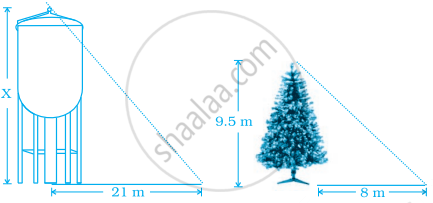
A water tank casts a shadow 21 m long. A tree of height 9.5 m casts a shadow 8 m long at the same time. The lengths of the shadows are directly proportional to their heights. Find the height of the tank.