Advertisements
Advertisements
Question
Area of a triangle = `1/2` base × ______.
Advertisements
Solution
Area of a triangle = `1/2` base × height.
APPEARS IN
RELATED QUESTIONS
If the points A(x, 2), B(−3, −4) and C(7, − 5) are collinear, then the value of x is:
(A) −63
(B) 63
(C) 60
(D) −60
If A(−4, 8), B(−3, −4), C(0, −5) and D(5, 6) are the vertices of a quadrilateral ABCD, find its area.
Prove that the points (a, b + c), (b, c + a) and (c, a + b) are collinear
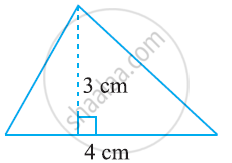
Find the area of the following triangle:
If a ≠ b ≠ c, prove that the points (a, a2), (b, b2), (c, c2) can never be collinear.
Show that the points A(3, 0), B(6, 4) and C(–1, 3) are the vertices of an isosceles right triangle.
For what value of x are the points A(−3, 12), B(7, 6) and C(x, 9) collinear.
The area of a trapezium is 475 cm2 and the height is 19 cm. Find the lengths of its two parallel sides if one side is 4 cm greater than the other.
If area of a triangular piece of cardboard is 90 cm2, then the length of altitude corresponding to 20 cm long base is ______ cm.
Using determinants, find the area of ΔPQR with vertices P(3, 1), Q(9, 3) and R(5, 7). Also, find the equation of line PQ using determinants.
