Advertisements
Advertisements
Question
Answer the following question in detail.
Derive an expression for the magnifying power of a simple microscope. Obtain its minimum and maximum values in terms of its focal length.
Advertisements
Solution
- Figure (a) shows the visual angle α made by an object when kept at the least distance of distinct vision (D = 25 cm). Without an optical instrument, this is the greatest possible visual angle as we cannot get the object closer than this.
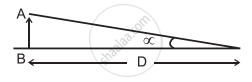
(a) Visual Angle α
(b) Visual Angle β - Figure (b) shows a convex lens forming an erect, virtual, and magnified image of the same object when placed within the focus.
- The visual angle β of the object and the image, in this case, is the same. However, this time the viewer is looking at the image which is not closer than D. Hence the same object is now at a distance smaller than D.
- Angular magnification or magnifying power, in this case, is given by
M = `"Visual angle of the image"/"Visual angle of the object at D"=β/α`
For small angles
M = `β/α≈(tan(β))/(tan(α))=("BA/PA")/"BA/D"="D"/"u"` - For maximum magnifying power, the image should be at D. For a thin lens, considering thin lens formula, `1/"f"=1/"v"-1/"u"`
In case of simple microscope,
f = +f, v = – D, u = – u and M = Mmax
∴ `1/"f"=1/-"D"-1/-"u"`
∴ `"D"/"f"="D"/-"D"+"D"/"u"`
As, M = `"D"/"u"`,
Mmax = `1+"D"/"f"` - For minimum magnifying power, v = ∞ and u = f (numerically)
∴ Mmin = `"D"/"u"="D"/"f"`
APPEARS IN
RELATED QUESTIONS
Answer the following question in detail.
Define and describe the magnifying power of an optical instrument.
Answer the following question in detail.
What is a terrestrial telescope and an astronomical telescope?
Answer the following question in detail.
Obtain the expressions for magnifying power and the length of an astronomical telescope under normal adjustments.
Answer the following question in detail.
What is the limitation in increasing the magnifying powers of a compound microscope?
What is the use of collimator in a spectrmeter?
What is myopia?
What is the remedy of myopia?
What is presbyopia?
Discuss about simple microscope and obtain the equations for magnification for near point focusing and normal focusing.
Obtain the equation for resolving the power of the microscope.
Discuss about astronomical telescope.
Mention different parts of the spectrometer.
A compound microscope has a magnifying power of 100 when the image is formed at infinity. The objective has a focal length of 0.5 cm and the tube length is 6.5 cm. What is the focal length of the eyepiece.
The near point and the far point for a person are 50 cm and 500 cm, respectively. Calculate the power of the lens the person should wear to read a book held in hand at 25 cm. What maximum distance is clearly visible for the person with this lens on the eye?
A light wave of wavelength λ is incident on a slit of width d. The resulting diffraction pattern is observed on a screen at a distance D. If linear width of the principal maxima is equal to the width of the slit, then the distance D is
There are four convex lenses L1, L2, L3 and L4 of focal length 2, 4, 6 and 8 cm, respectively. Two of these lenses from a telescope of length 10 cm and magnifying power 4. The objective and eye lenses are respectively
When a convex lens of 12.5 cm focal length is used as a magnifying glass, normal eye can see an object clearly at a distance of 25 cm. The magnifying power of the instrument is ____________.
The magnifying power of a telescope is high if its objective and eyepiece have respectively ______.
A simple microscope is used to see the object first in blue light and then in red light. Due to the change from blue to red light, what is the effect on its magnifying power?
The speed of light in media 'A' and 'B' are 2.0 × 1010 cm/s and 1.5 × 1010 cm/s respectively. A ray of light enters from medium B to A at an incident angle 'θ'. If the ray suffers total internal reflection, then ______.
An observer looks at a distant tree of height 10 m with a telescope of magnifying power of 20. To the observer the tree appears:
The image formed by an objective of a compound microscope is ______.
A camera objective has an aperture diameter of d. If the aperture is reduced to diameter d/2, the exposure time under identical conditions of light should be made ______.
