English
Tamil Nadu Board of Secondary EducationHSC Science Class 12

A compound microscope has a magnifying power of 100 when the image is formed at infinity. The objective has a focal length of 0.5 cm and the tube length is 6.5 cm. - Physics

Advertisements
Advertisements

Question

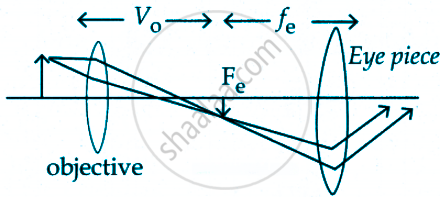
A compound microscope has a magnifying power of 100 when the image is formed at infinity. The objective has a focal length of 0.5 cm and the tube length is 6.5 cm. What is the focal length of the eyepiece.

Numerical
Advertisements

Solution

`"v"_circ + "f"_"e"` = 6.5 cm   ....(1)

m = `"v"_circ/"u"_circ xx "D"/"f"_"e"` [taking D = 25 cm]

`=> "m" = - [1 - "v"_circ/"f"_circ] "D"/"f"_"e"`

`100 = - [1 - "v"_circ/0.5] 25/"f"_"e"`

`100 "f"_"e" = - (1 - 2"v"_circ) xx 25`

`2"v"_circ - 4 "f"_"e" = 1`   .....(2)

Solving equation (1) and (2) we can get,

v0 = 4.5 cm and fe = 2 cm
shaalaa.com
Optical Instruments
  Is there an error in this question or solution?
Chapter 7: Wave Optics - Evaluation [Page 105]

APPEARS IN

Samacheer Kalvi Physics - Volume 1 and 2 [English] Class 12 TN Board
Chapter 7 Wave Optics
Evaluation | Q 10. | Page 105

RELATED QUESTIONS

Answer the following question in detail.

What is a terrestrial telescope and an astronomical telescope?


Answer the following question in detail.

What is the limitation in increasing the magnifying powers of a simple microscope?


Answer the following question in detail.

What is the limitation in increasing the magnifying powers of a compound microscope?


What is the near point focusing?


What are the advantages and disadvantages of using a reflecting telescope?


What is myopia?


What is the remedy of myopia?


What is hypermetropia?


What is presbyopia?


Mention different parts of the spectrometer.


Explain the preliminary adjustments of the spectrometer.


A compound microscope has a magnification of 30. The focal length of eye piece is 5 cm. Assuming the final image to be at least distance of distinct vision, find the magnification produced by the objective.


There are four convex lenses L1, L2, L3 and L4 of focal length 2, 4, 6 and 8 cm, respectively. Two of these lenses from a telescope of length 10 cm and magnifying power 4. The objective and eye lenses are respectively


When a convex lens of 12.5 cm focal length is used as a magnifying glass, normal eye can see an object clearly at a distance of 25 cm. The magnifying power of the instrument is ____________.


If astronomical telescope of length 1.53 m has magnifying power of magnitude 50, the values of fo and fe are ____________.


The magnifying power of a telescope is nine. When it is adjusted for parallel rays, the distance between the objective and eyepiece is 20 cm. The focal length of objective and eyepiece are respectively.


An object viewed from a near point distance of 25 cm, using a microscopic lens with magnification '6', gives an unresolved image. A resolved image is observed at infinite distance with a total magnification double the earlier using an eyepiece along with the given lens and a tube of length 0.6 m, if the focal length of the eyepiece is equal to ______ cm.


Magnification produced by astronomical telescope for normal adjustment is 10 and length of telescope is 1.1 m. The magnification when the image is formed at least distance of distinct vision (D = 25 cm) is ______.


Share
Notifications

Englishहिंदीमराठी


      Forgot password?
Use app×