Advertisements
Advertisements
प्रश्न
A compound microscope has a magnifying power of 100 when the image is formed at infinity. The objective has a focal length of 0.5 cm and the tube length is 6.5 cm. What is the focal length of the eyepiece.
Advertisements
उत्तर
`"v"_circ + "f"_"e"` = 6.5 cm ....(1)
m = `"v"_circ/"u"_circ xx "D"/"f"_"e"` [taking D = 25 cm]
`=> "m" = - [1 - "v"_circ/"f"_circ] "D"/"f"_"e"`
`100 = - [1 - "v"_circ/0.5] 25/"f"_"e"`
`100 "f"_"e" = - (1 - 2"v"_circ) xx 25`
`2"v"_circ - 4 "f"_"e" = 1` .....(2)
Solving equation (1) and (2) we can get,
v0 = 4.5 cm and fe = 2 cm
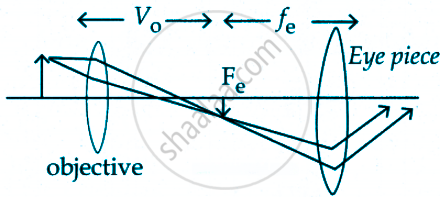
APPEARS IN
संबंधित प्रश्न
Answer the following question in detail.
Derive an expression for the magnifying power of a simple microscope. Obtain its minimum and maximum values in terms of its focal length.
Answer the following question in detail.
What is a terrestrial telescope and an astronomical telescope?
Answer the following question in detail.
Obtain the expressions for magnifying power and the length of an astronomical telescope under normal adjustments.
Answer the following question in detail.
What is the limitation in increasing the magnifying powers of the astronomical telescope?
Discuss about simple microscope and obtain the equations for magnification for near point focusing and normal focusing.
What is the near point focusing?
Why is oil-immersed objective preferred in a microscope?
What are the uses of spectrometer?
What is hypermetropia?
What is astigmatism? What is its remedy?
Discuss about simple microscope and obtain the equations for magnification for near point focusing and normal focusing.
Obtain the equation for resolving the power of the microscope.
Discuss about astronomical telescope.
A compound microscope has a magnification of 30. The focal length of eye piece is 5 cm. Assuming the final image to be at least distance of distinct vision, find the magnification produced by the objective.
The magnifying power of a telescope is high if its objective and eyepiece have respectively ______.
A simple microscope is used to see the object first in blue light and then in red light. Due to the change from blue to red light, what is the effect on its magnifying power?
An observer looks at a distant tree of height 10 m with a telescope of magnifying power of 20. To the observer the tree appears:
In the adjoining figure, AB represents the incident ray, and BK is the reflected ray. If angle BCF = θ, then ∠BFP is given by ______.
