हिंदी

Answer the following question in detail. Derive an expression for magnifying power of a simple microscope. Obtain its minimum and maximum values in terms of its focal length. - Physics

Advertisements
Advertisements

प्रश्न

Answer the following question in detail.

Derive an expression for the magnifying power of a simple microscope. Obtain its minimum and maximum values in terms of its focal length.

संक्षेप में उत्तर
Advertisements

उत्तर

  1. Figure (a) shows the visual angle α made by an object when kept at the least distance of distinct vision (D = 25 cm). Without an optical instrument, this is the greatest possible visual angle as we cannot get the object closer than this.
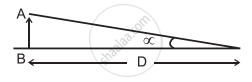
              (a) Visual Angle α


                   (b) Visual Angle β
  2. Figure (b) shows a convex lens forming an erect, virtual, and magnified image of the same object when placed within the focus.
  3. The visual angle β of the object and the image, in this case, is the same. However, this time the viewer is looking at the image which is not closer than D. Hence the same object is now at a distance smaller than D.
  4. Angular magnification or magnifying power, in this case, is given by
    M = `"Visual angle of the image"/"Visual angle of the object at D"=β/α`
    For small angles
    M = `β/α≈(tan(β))/(tan(α))=("BA/PA")/"BA/D"="D"/"u"`
  5. For maximum magnifying power, the image should be at D. For a thin lens, considering thin lens formula, `1/"f"=1/"v"-1/"u"`
    In case of simple microscope,
    f = +f, v = – D, u = – u and M = Mmax
    ∴ `1/"f"=1/-"D"-1/-"u"`
    ∴ `"D"/"f"="D"/-"D"+"D"/"u"`
    As, M = `"D"/"u"`,
    Mmax = `1+"D"/"f"`
  6. For minimum magnifying power, v = ∞ and u = f (numerically)
    ∴ Mmin = `"D"/"u"="D"/"f"`
shaalaa.com
Optical Instruments
  क्या इस प्रश्न या उत्तर में कोई त्रुटि है?
अध्याय 9: Optics - Exercises [पृष्ठ १८६]

APPEARS IN

बालभारती Physics [English] Standard 11 Maharashtra State Board
अध्याय 9 Optics
Exercises | Q 3. (viii) | पृष्ठ १८६

संबंधित प्रश्न

Answer the following question in detail.

How does magnifying power differ from linear or lateral magnification?


Answer the following question in detail.

What is a terrestrial telescope and an astronomical telescope?


Answer the following question in detail.

What is the limitation in increasing the magnifying powers of a simple microscope?


Answer the following question in detail.

What is the limitation in increasing the magnifying powers of a compound microscope?


Answer the following question in detail.

What is the limitation in increasing the magnifying powers of the astronomical telescope?


Discuss about simple microscope and obtain the equations for magnification for near point focusing and normal focusing.


What is the near point focusing?


What is the use of collimator in a spectrmeter?


What are the uses of spectrometer?


What is hypermetropia?


What is astigmatism? What is its remedy?


Discuss about simple microscope and obtain the equations for magnification for near point focusing and normal focusing.


Mention different parts of the spectrometer.


Explain the preliminary adjustments of the spectrometer.


Explain the experimental determination of the material of the prism using a spectrometer.


A compound microscope has a magnifying power of 100 when the image is formed at infinity. The objective has a focal length of 0.5 cm and the tube length is 6.5 cm. What is the focal length of the eyepiece.


A light wave of wavelength λ is incident on a slit of width d. The resulting diffraction pattern is observed on a screen at a distance D. If linear width of the principal maxima is equal to the width of the slit, then the distance D is


There are four convex lenses L1, L2, L3 and L4 of focal length 2, 4, 6 and 8 cm, respectively. Two of these lenses from a telescope of length 10 cm and magnifying power 4. The objective and eye lenses are respectively


If astronomical telescope of length 1.53 m has magnifying power of magnitude 50, the values of fo and fe are ____________.


The magnifying power of a telescope is high if its objective and eyepiece have respectively ______.


A simple microscope is used to see the object first in blue light and then in red light. Due to the change from blue to red light, what is the effect on its magnifying power?


Magnification produced by astronomical telescope for normal adjustment is 10 and length of telescope is 1.1 m. The magnification when the image is formed at least distance of distinct vision (D = 25 cm) is ______.


An observer looks at a distant tree of height 10 m with a telescope of magnifying power of 20. To the observer the tree appears:


A camera objective has an aperture diameter of d. If the aperture is reduced to diameter d/2, the exposure time under identical conditions of light should be made ______.


Share
Notifications

Englishहिंदीमराठी


      Forgot password?
Use app×