Advertisements
Advertisements
Question
Answer the following question:
Find the area of quadrilateral whose vertices are A(0, −4), B(4, 0), C(−4, 0), D(0, 4)
Advertisements
Solution
A(0, −4), B(4, 0), C(−4, 0), D(0, 4)
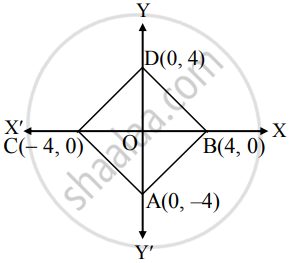
A`(square"ABDC")` = A(ΔABC) + A(ΔBDC)
Area of a triangle = `1/2|(x_1, y_1, 1),(x_2, y_2, 1),(x_3, y_3, 1)|`
∴ A(ΔABC) = `1/2|(0, -4, 1),(4, 0, 1),(-4, 0, 1)|`
= `1/2[0 - (-4)(4 + 4) + 1(0 - 0)]`
= `1/2(32)`
= 16 sq. units
A(ΔBDC) = `1/2|(4, 0, 1),(0, 4, 1),(-4, 0, 1)|`
= `1/2[4(4 - 0) - 0 + 1(0 + 16)]`
= `1/2[4(4) + 1(16)]`
= `1/2(16 + 16)`
= `1/2(32)`
= 16 sq. units
∴ A`(square"ABDC")` = A(ΔABC) + A(ΔBDC)
= 16 + 16
= 32 sq. units
APPEARS IN
RELATED QUESTIONS
Find the area of triangle whose vertices are
A(5, 8), B(5, 0) C(1, 0)
Find the area of triangle whose vertices are
`"P"(3/2, 1), "Q"(4, 2), "R"(4, (-1)/2)`
Find the area of triangle whose vertices are
M(0, 5), N(−2, 3), T(1, −4)
Find the area of quadrilateral whose vertices are
A(−3, 1), B(−2, −2), C(3, -1), D(1, 4)
Find the value of k, if the area of triangle whose vertices are P(k, 0), Q(2, 2), R(4, 3) is `3/2 "sq.unit"`
Examine the collinearity of the following set of point:
A(3, −1), B(0, −3), C(12, 5)
Examine the collinearity of the following set of point:
P(3, −5), Q(6, 1), R(4, 2)
Examine the collinearity of the following set of point:
`"L"(0, 1/2), "M"(2, -1), "N"(-4, 7/2)`
Select the correct option from the given alternatives:
If A(0,0), B(1,3) and C(k,0) are vertices of triangle ABC whose area is 3 sq.units then value of k is
Answer the following question:
Find the area of triangle whose vertices are A(−1, 2), B(2, 4), C(0, 0)
Answer the following question:
Find the area of triangle whose vertices are P(3, 6), Q(−1, 3), R(2, −1)
Answer the following question:
Find the value of k:
If area of triangle is 4 square unit and vertices are P(k, 0), Q(4, 0), R(0, 2)
Answer the following question:
Show that the following points are collinear by determinant:
L(2,5), M(5,7), N(8,9)
Answer the following question:
Show that the following points are collinear by determinant:
P(5,1), Q(1,−1), R(11,4)
