Advertisements
Advertisements
Question
Answer the following in brief.
How will you determine activation energy graphically using the Arrhenius equation?
Advertisements
Solution
Graphical representation of activation energy
Arrhenius equation is `"k" = "Ae"^((-"E"_"a")/("RT"))`
Taking the logarithm of both sides of Eqn. we obtain
In k = -`"E"_"a"/"RT" + "In A"`
Converting the natural base to base 10 we write
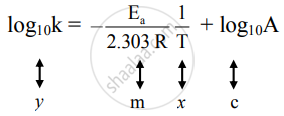
This equation is of the form of straight-line y = mx + c.
The Arrhenius plot of log10k versus `1/"T"` gives a straight line as shown in the diagram. A slope of the line is `-"E"_"a"/(2.303 "R")` with its intercept being log10A.
From a slope of the line, the activation energy can be determined.
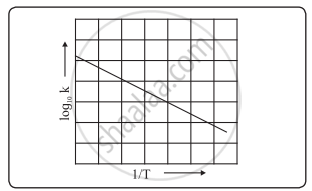
Variation of log10k with 1/T
APPEARS IN
RELATED QUESTIONS
Answer the following in one or two sentences.
Write the Arrhenius equation and explain the terms involved in it.
Answer the following in brief.
Explain graphically the effect of temperature on the rate of reaction.
Solve
What is the energy of activation of a reaction whose rate constant doubles when the temperature changes from 303 K to 313 K?
The rate constant of a reaction at 500°C is 1.6 × 10³ M−1 s−1. What is the frequency factor of the reaction if its activation energy is 56 kJ/mol?
How will you determine activation energy from rate constants at two different temperatures?
Which among the following is correct when energy of activation, Ea of the catalyzed reaction decreases at constant temperature and for same concentration?
A catalyst lowers the activation energy of a certain reaction from 83.314 to 75 kJ mol−1 at 500 K. What will be the rate of reaction as compared to uncatalysed reaction? Assume other things are equal.
Which among the following equation represents Arrhenius equation?
Slope of the straight line obtained by plotting log10k against represents what term?
Write the mathematical equation between reaction rate constant and its activation energy.
Explain with the help of Arrhenius equation, how does the rate of reaction changes with activation energy.
Explain with the help of Arrhenius equation, how does the rate of reaction changes with temperature.
Explain with the help of Arrhenius equation, how does the rate of reaction changes with activation energy.
Explain, with the help of the Arrhenius equation, how does the rate of reaction changes with temperature.
Explain, with the help of the Arrhenius equation, how does the rate of reaction changes with activation energy.
Explain with the help of the Arrhenius equation, how do the rate of reaction changes with activation energy.
Explain with the help of Arrhenius equation, how does the rate of reaction changes with temperature.
Explain with the help of Arrhenius equation, how does the rate of reaction changes with activation energy.
Explain with the help of Arrhenius equation, how does the rate of reaction changes with temperature.
Explain with the help of Arrhenius equation, how does the rate of reaction changes with activation energy.
Explain with the help of Arrhenius equation, how does the rate of reaction changes with temperature.
Explain with the help of Arrhenius equation, how does the rate of reaction changes with activation energy.
The formation of micelles takes place only above ______.
Calculate activation energy for a reaction if its rate doubles when temperature is raised from 20°C to 35°C (R = 8.314 J K−1 mol−1).
