Advertisements
Advertisements
Question
Answer the question in a short paragraph.
What difference does the author note between the flute seller and the other hawkers?
Advertisements
Solution
The author notes that while the other hawkers shouted out their wares, the flute seller did not. He simply played a flute, slowly and meditatively, without excessive display.
RELATED QUESTIONS
The Shehnai of Bismillah Khan Thinking about the text :
Tick the right answer.
Bismillah Khan’s first trip abroad was to (Afghanistan, U.S.A., Canada).
Thinking about the Poem
How does the poet suggest that all people on earth are the same?
Bill Bryson “ached to be suave”. Is he successful in his mission? List his ‘unsuave’ ways.
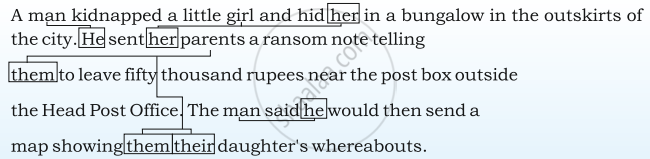
Look at the passage below and study how the personal pronouns refer to different people.
Know all about Chess . Read and enjoy :
You now know a little about Koneru Humpychess player but do you know how to play chess? Let's know more about it:
Have you ever played chess? Did you know that chess is the oldest skill game in the world? But chess is more than just a. game of skill. It can tell you much about the way people lived in medieval times. If you look at the way a chess board is set up, then study the pieces and how they are used, you will realise that chess is a history of medieval times in miniature. The six different chess pieces on the board represent a cross section of medieval life with its many ceremonies grandeur ,and wars .
Chess was played many centuries ago in China, India, and Persia. No one really knows for sure in which country it originated. Then, in the eighth century, armies of Arabs known as Moors invaded Persia. The Moors learned chess from the Persians. When the Moors later invaded Spain, the soldiers brought the game of chess with them. Soon the Spanish were playing chess, too. From Spain, the popularity of chess quickly spread throughout all of Europe
Europeans gave chess pieces the names we know today; they probably had trouble pronouncing and spelling the Persian names, so they modernized them to reflect the way they lived. Today, the names certainly aren't modem but a thousand years ago they represented the very way in which both ordinary people and persons of rank lived their lives.
The pawns on the chess board represent serfs, or labourers. There are more of them than any other piece on the board, and often they are sacrificed to save the more valuable pieces. In medieval times, serfs were considered no more than the property of landowners, or chattels. Life was brutally hard for serfs during this era of history. They worked hard and died young. They were often left unprotected while wars raged around them. They could be traded, used as a diversion, or even sacrificed to allow the landowners to escape harm.
The castle piece on a chess board is the home, or the refuge, just as it was a home in medieval times. In Chess, each side has two castles, or rooks, as they are sometimes called.
The knight on a chess board represents the professional soldier of medieval times whose job it was to protect persons of rank, and there are two of them per side in a game of chess. Knights in a game of chess are more important than pawns, but less important than bishops, kings, or queens. Their purpose in the game of chess is to protect the more important pieces, and they can be sacrificed to save those pieces just as pawns can.
There is a bishop in the game of chess, who represents the church. The Church was a rich and mighty force in medieval times, and religion played a large part in every person's life. It is no wonder that a figure that represented the concept of religion found its way into the game. A bishop was the name for a priest in the Catholic church who had risen through the ranks to a more powerful position. In the game of chess, there are two bishops for each side.
The queen is the only piece on the board during a chess game that represents a woman, and she is the most powerful piece of the game.
The king is the tallest piece on the board, and is as well defended on the chessboard as in medieval life. In medieval times, the surrender of the king would mean the loss of the kingdom to invading armies and that could mean change for the worse. It was to everyone's advantage, from the lowest serf to the highest-ranking official, to keep the king safe from harm.. The king is the most important, but not the most powerful piece in chess. If you do not protect your king, you lose the game.
The next time you set up your chessboard and get ready 7 to play a friendly game or two, think of chess as a 6 history lesson. The pieces on the board represent a way 5 of life that is no more, and the real life dramas that occurred in medieval times are now only a game.
What does he plant who plants a tree?
He plants, in sap and leaf and wood,
In love of home and loyalty
And far-cast thought of civic good____
His blessing on the neighbourhood,
Who in the hollow of his hand
Holds all the growth of all our land____
A nation's growth from sea to sea
Stirs in his heart who plants a tree.
Read the lines given above and answer the question that follow:
What is the reference to in the phrase ‘stirs in his heart’?
The black man's face bespoke revenge
As the fire passed from his sight.
For all he saw in his stick of wood
Was a chance to spite the white.
The last man of this forlorn group
Did nought except for gain.
Giving only to those who gave
Was how he played the game.
Their logs held tight in death's still hands
Was proof of human sin.
They didn't die from the cold without
They died from the cold within.
Read the lines given above and answer the question that follow.
Why did the black man refuse to use his stick of wood?
Some are like fields of sunlit corn,
Meet for a bride on her bridal morn,
Some, like the flame of her marriage fire,
Or, rich with the hue of her heart's desire,
Tinkling,luminous,tender, and clear,
Like her bridal laughter and bridal tear.
Read the lines given above and answer the question that follow.
Mention the colours of the bangles in this stanza. What do they represent?
'All right!' you 'll cry.'All right!' you'll say,
'But if we take the set away,
What shall we do to entertain
Our darling children?Please explain!'
We'll answer this by asking you,
'What used the darling ones to do?
'How used they keep themselves contented
Before this monster was invented?'
Have you forgotten? Don't you know?
We'll say it very loud and slow:
THEY ... USED ... TO ... READ! They'd READ and READ,
AND READ and READ, and then proceed
To READ some more. Great Scott! Gadzooks!
One half their lives was reading books!
The nursery shelves held books galore!
Books cluttered up the nursery floor!
And in the bedroom, by the bed,
More books were waiting to be read!
Read the lines given above and answer the question given below.
Explain with reference to context.
Answer the following question.
What was Soapy’s first plan? Why did it not work?
Complete the sentence below by appropriately using anyone of the following:
if you want to/if you don’t want to/if you want him to
Don’t eat it____________________.
Mark the right item.
When the old couple became rich, they
What happened when the king hear his courtiers talking about Hilsa fish?
Friendship is a great relation. We all must treasure our friends. Explain.
What do you know about Golu?
What do you know about Tansen’s life before he joined Akbar’s court?
What have certain doctors found about dreams?
What happens when the winds blow?
Multiple Choice Question:
When does the kite lose all its energy?
Answer the following question:
Where was Kalpana Chawla born? Why is she called an Indian – American?
