Advertisements
Advertisements
Question
Answer the following question in 30 to 40 words.
On two occasions Bruno ate/drank something that should not be eaten /drunk. What
happened to him on these occasions?
Advertisements
Solution
Bruno ate some poison-barium carbonate He also vomited and breathed heavily, but was later cured. In another incident, he drank nearly a gallon of old engine oil. Fortunately, he remained unaffected meant for the rats, which paralysed and weakened him.
RELATED QUESTIONS
Has Lushkoff become a beggar by circumstance or by choice?
Answer these question in one or two sentences. (The paragraph numbers within brackets provide clues to the answer.)
Why was the ‘holy man’ who gave Santosh’s mother his blessings surprised?
(a) Given below are five lines from a poem but they are not in the right order.
Get into groups of four. Read the lines and put them in the right order. Read the version that you develop to the whole class.
| The voice of thunder declares my arrival. |
| I emerge from the heart of the sea. |
| I descend and embrace the flowers. |
| I am dotted silver threads dropped from heaven. |
| The rainbow announces my departure. |
(b) Who is ‘I’ in these lines?
(c) Imagining yourself as the subject of this poem, write five lines about yourself in less than five minutes.
You may like to
- define yourself
- state what you do
- explain why people like/dislike you
- mention any other characteristic about yourself
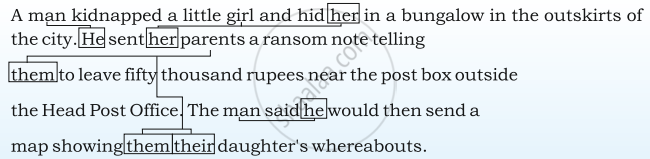
Look at the passage below and study how the personal pronouns refer to different people.
A free bird leaps on the back
Of the wind and floats downstream
Till the current ends and dips his wing
In the orange suns rays
And dares to claim the sky.
Read the above lines and answer the question that follow.
What does the caged bird’s singing reveal about him?
It was my business to cross the bridge, explore the bridge head 3 beyond and find out to what point the enemy had advanced. I did this and returned over the bridge. There were not so many carts now and very few people on foot, but the old man was still there.’’Where do you come from?” I asked him.
“From San Carlos,” he said, and smiled.
That was his native town and so it gave him pleasure to mention it and he smiled.
“I was taking care of animals,” he explained.
“Oh,” I said, not quite understanding.
“Yes,” he said, “I stayed, you see, taking care of animals. I was the last one to leave the town of San Carlos.”
He did not look like a shepherd nor a herdsman and I looked at his black dusty clothes and his gray dusty face and his steel rimmed spectacles and said, “What animals were they?”
“Various animals,” he said, and shook his head. “I had to leave them.”
Read the extract given below and answer the question that follow.
Why did the old man leave his hometown? Why did he leave it reluctantly?
The boy looked up. He took his hands from his face and looked up at his teacher. The light from Mr. Oliver’s torch fell on the boy’s face, if you could call it a face. He had no eyes, ears, nose or mouth. It was just a round smooth head with a school cap on top of it.
And that’s where the story should end, as indeed it has for several people who have had similar experiences and dropped dead of inexplicable heart attacks. But for Mr. Oliver, it did not end there. The torch fell from his trembling hand. He turned and scrambled down the path, running blindly through the trees and calling for help. He was still running towards the school buildings when he saw a lantern swinging in the middle of the path. Mr. Oliver had never before been so pleased to see the night watchman. He stumbled up to the watchman, gasping for breath and speaking incoherently.
What is it, Sahib? Asked the watchman, has there been an accident? Why are you running?
I saw something, something horrible, a boy weeping in the forest and he had no face.
No face, Sahib?
No eyes, no nose, mouth, nothing.
Do you mean it was like this, Sahib? asked the watchman, and raised the lamp to his own face. The watchman had no eyes, no ears, no features at all, not even an eyebrow. The wind blew the lamp out and Mr. Oliver had his heart attack.
Read the extract given below and answer the question that follow.
What was Mr Oliver’s reaction when he saw the faceless boy? Whom did he stumble into?
After washing from his hands and face the dust and soil of work, Joe left the kitchen, and went to the little bedroom. A pair of large bright eyes looked up at him from the snowy bed; looked at him tenderly, gratefully, pleadingly. How his heart swelled in his bosom! With what a quicker motion came the heart-beats! Joe sat down, and now, for the first time, examining the thin free carefully under the lamp light, saw that it was an attractive face, and full of a childish sweetness which suffering had not been able to obliterate.
“Your name is Maggie?” he said, as he sat down and took her soft little hand in his.
“Yes, sir.” Her voice struck a chord that quivered in a low strain of music.
“Have you been sick long?”
“Yes, sir.” What a sweet patience was in her tone!
“Has the doctor been to see you?”
“He used to come”
“But not lately?”
“No, sir.”
Read the extract given below and answer the questions that follow.
What was Joe’s reaction to the look Maggie gave him’
Then, trying to hide my nervousness, I added, “How are you?”
“I’m fine. The question is: How are you?“
“What do you mean?” 1 asked “Something must be eating you,” he said—proud the way foreigners are when they’ve mastered a bit of American slang. “You should be able to qualify with your eyes closed.”
“Believe me, I know it,” I told him—and it felt good to say that to someone.
For the next few minutes we talked together. I didn’t tell Long what was “eating” me, but he seemed to understand my anger, and he took pains to reassure me. Although he’d been schooled in the Nazi youth movement, he didn’t believe in the Aryan-supremacy business any more than I did. We laughed over the fact that he really looked the part, though. An inch taller than I, he had a lean, muscular frame, clear blue eyes, blond hair and a strikingly handsome, chiseled face. Finally, seeing that I had calmed down somewhat, he pointed to the take-off board.
“Look,” he said. “Why don’t you draw a line a few inches in back of the board and aim at making your take-off from there? You’ll be sure not to foul, and you certainly ought to jump far enough to qualify. What does it matter if you’re not first in the trials? Tomorrow is what counts.”
Read the extract given below and answer the question that follow.
What was actually eating Jesse Owens?
Read the following passage carefully and answer the questions that follow:
Granny knew I'd been in the train for two nights, and she had a huge breakfast ready for me. Later she told me there'd been a letter from Uncle Ken.
'He says he's the manager in Fitpo's hotel in Simla,' she said. 'The salary is very good. It's a steady job and I hope he keeps it.' Three days later Uncle Ken was on the veranda steps with his bedding roll and battered suitcase. 'Have you given up the hotel job?' asked Granny. 'No,' said Uncle Ken. 'They have closed down.' I hope it wasn't because of you.' 'No, Aunt Ellen_ The bigger hotels in the hill stations are closing down. 'Well, never mind. Come along and have your lunch. Over lunch; Uncle Ken talked very seriously about ways and means of earning a living. There is only one taxi in the whole of Debra, he mused. 'Surely there is business for another?' `I'm sure there is,' said Granny. 'But where does it get you? In the first place, you don't have a taxi. And in the second place, you can't drive.' I can soon learn. There's a driving school in town. And I can use Uncle's old car.' 'I don't think it will run now,' said Granny. 'Of course, it will. It just needs some oiling and greasing and a spot of paint.' 'All right, learn to drive.' So, Uncle Ken joined the driving school.After a month Uncle Ken announced that he could drive and that he was taking the car out for a trial run. 'You haven't got your license yet,' said Granny. 'Oh, I won't take it far,' said Uncle Ken. 'Just down the road and back again.' He spent all morning cleaning up the car. Granny gave him money for a can of petrol. After tea, Uncle Ken said, 'Come along, Ruskin, hop in and I will give you a ride. Bring Mohan along too.' Mohan and I needed no urging. We got into the car beside Uncle Ken. 'Now don't go too fast, Ken,' said Granny anxiously. 'You are not used to the car as yet.' Uncle Ken nodded and smiled and gave two sharp toots on the horn. He was feeling pleased with himself. Driving through the gate, he nearly ran over a cat. Miss Kellner, coming out for her evening rickshaw ride, saw Uncle Ken at the wheel of the car and ran indoors again. [40] Uncle Ken drove straight and fast, tootling the horn without a break. At the end of the road there was a roundabout. 'We’ll turn here,' said Uncle Ken, 'and then drive back again.' He turned tt;e steering wheel, we began going round the roundabout, but the steering wheel wouldn't turn all the way, not as much as Uncle Ken would have liked it to... So, instead he went on - and straight through the Maharaja of Jetpur’s garden wall. It was a single-brick wall, and the car knocked it down and emerged on the other, side without any damage to the car or any of its occupants. Uncle Ken brought it to a halt in the middle of the Maharaja's lawn. Running across the grass came the Maharaja himself. When he saw that it was Uncle Ken at the wheel, the Maharaja beamed with pleasure. 'Delighted to see you, old chap!' he exclaimed. 'Jolly decent of you to drop in again. How about a game of tennis?'
(a) Give the meaning of the following words as used in the passage:
One word answers or short phrases will be accepted.
(i) battered
(ii) bused
(iii) emerged
(b) Answer the following questions briefly in your own words.
(i) Why did Granny hope Uncle Ken would keep his job at Fitgo's hotel?
(ii) When Uncle Ken arrived with his luggage, Granny remarked that she hoped the hotel had not closed down because of him. What does this remark tell you about Uncle Ken?
(iii) Why did Uncle Ken think that driving a taxi in Dehra would be profitable?
(iv) Which sentence tells you that the narrator and his friend were waiting to be invited for a drive in a car?
(v) Why did Miss Kellner run indoors when she saw Uncle Ken at the wheel of the car?
(vi) What was Uncle Ken's intention at the roundabout?
(c)
(I) In not more than 60 words, describe what happened after the car went through the wall.
(ii) Give a title to your summary in 3(c)(i). Give a reason to justify choice of the title.
Read the following sentences.
a) If she knows we have a cat, Paati will leave the house.
(b) She won’t be so upset if she knows about the poor beggar with sores on his feet.
c) If the chappals do fit, will you really not mind? Notice that each sentence consists of two parts. The first part begins with ‘if’. It is known as if-clause.
Rewrite each of the following pairs of sentences as a single sentence. Use ‘if’ at the beginning of the sentence
Work hard. You’ll pass the examination in the first division
Find in the poem lines that match the following. Read both one after the other.
The rebel refuses to cut his hair.
Why was it necessary to train Kari to he good?
What, according to the python, were the advantages of a long nose (trunk)?
What made the farmer’s wife blind with rage?
- What happens if Raga Deepak is sung properly?
- Why did Tansen’s enemies want him to sing the Raga?
What was troubling the talking fan?
Who was the bearded man?
Study the following phrases and their meanings. Use them appropriately to complete the sentences that follow.
The police are …………… the matter thoroughly.
Referring closely, to Act III Scene III, relate the stern warning of Ariel to the "three men of sin". What impact does his warning have on the three sinners?
