Advertisements
Advertisements
प्रश्न
Answer the following question in 30 to 40 words.
On two occasions Bruno ate/drank something that should not be eaten /drunk. What
happened to him on these occasions?
Advertisements
उत्तर
Bruno ate some poison-barium carbonate He also vomited and breathed heavily, but was later cured. In another incident, he drank nearly a gallon of old engine oil. Fortunately, he remained unaffected meant for the rats, which paralysed and weakened him.
संबंधित प्रश्न
Answer of these question in a short paragraph (about 30 words).
Why was Margie doing badly in geography? What did the County Inspector do to help
her?
Find the words in the text which show Ustad Bismillah Khan’s feelings about the items listed below. Then mark a tick (✓ ) in the correct column. Discuss your answers in class.
| Bismillah Khan’s Feelings about | Positive | Negative | Neutral |
| 1. teaching children music | |||
| 2. the film world | |||
| 3. migrating to the U.S.A | |||
| 4. playing at temples | |||
| 5. getting the Bharat Ratna | |||
| 6. the banks of the Ganga | |||
| 7. leaving Benaras and Dumraon |
Match the meanings with the words/expressions in italic, and write the appropriate
meaning next to the sentence.
Wait until I tell his story — it will make your hair stand on end.
Complete the following statement.
During the Everest expedition, her seniors in the team admired her _________ while _________endeared her to fellow climbers.
Both, all, neither, none
| One | Of them | |
| Two | ||
| Three | is a ... | |
| Neither | are ... s. | |
| All | ||
| None | ||
| Both |
Read the comic strip based on. H.G. Wells' novells.


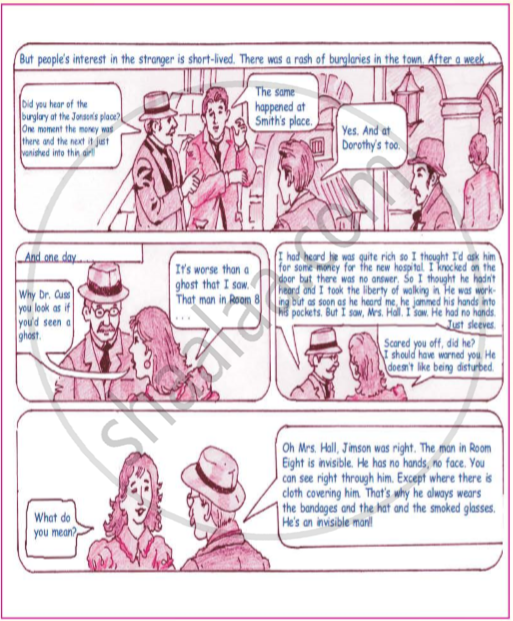
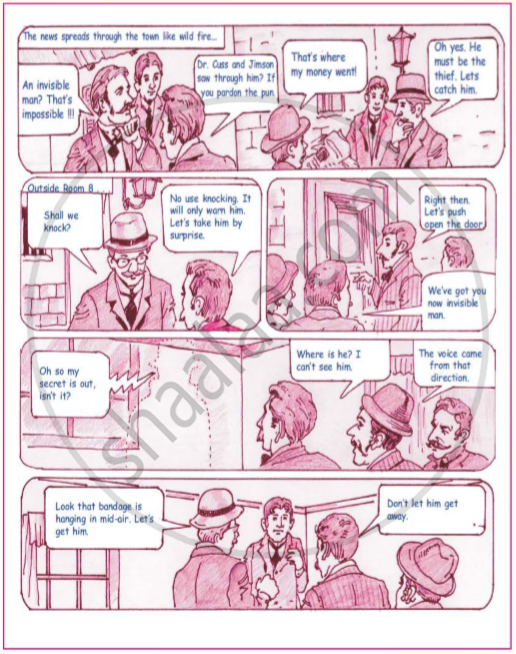
Answer the questions by ticking the correct option.
(a) The strange-looking man wanted ....
(i) the best room at the inn.
(ii} a room with a fire and a good lock.
(iii} a room with a good view.
(iv) a room where he could work quietly.
(b) Jimson was suspicious of the stranger because ...
(i} he did not answer Jimson's questions.
(ii} he did not want to talk about the weather.
(iii} he kept his back turned towards Jimson at all times.
(iv) he shouted atJimson when he entered his room.
(c) The people of the town gossiped about the stranger as ...
(i} he did not go out or talk to anyone in the town.
(ii} he had met with an accident and his face was bandaged.
(iii} he was new to the town and behaved rudely.
(iv) he stayed in his room and did not show his face to anyone.
(d) 'There was a rush of burglaries in the town. This means that ________
(i} there were many robberies in the town.
(ii) a few people in the town had seen a rob her.
(iii} the burglaries in the town were done in a rush.
(iv) the burglar was a rash and careless man.
(e) Although Jimson and Dr Cuss are suspicious of the strange guest, Mrs Hall tolerates him because ....
(i} she is not superstitious or ignorant.
(ii) she is sorry for the stranger who is bandaged.
(iii} the stranger is paying her a good amount of money for the room.
(iv} the stranger is polite and kind to Mrs Hall at all times.
(f) The stranger who was staying at the inn can be described as being ....
(I} violent
(ii} upright
(iii} dishonest
(iv) sensible
Some are like fields of sunlit corn,
Meet for a bride on her bridal morn,
Some, like the flame of her marriage fire,
Or, rich with the hue of her heart's desire,
Tinkling,luminous,tender, and clear,
Like her bridal laughter and bridal tear.
Read the lines given above and answer the question that follow.
The poet has used several expressions which form pictures in the readers mind “fields of sunlit corn” and “circles of light”. Pick out more such expressions from the poem.
I wandered lonely as a Cloud
That floats on high o'er vales and Hills,
When all at once I saw a crowd,
A host, of golden Daffodils;
Beside the Lake, beneath the trees,
Fluttering and dancing in the breeze.
Read the lines given above and answer the question that follow.
Where were the daffodils and what where they doing ?
Abou Ben Adhem (may his tribe increase!)
Awoke one night from a deep dream of peace,
And saw, within the moonlight in his room,
Making it rich, and like a lily in bloom,
An angel writing in a book of gold:-
Read the lines given above and answer the following question.
Name the poet of the given lines.
“I love the West,” said the girl irrelevantly. Her eyes were shining softly. She looked away out the car window. She began to speak truly and simply without the gloss of style and manner: “Mamma and I spent the summer in Deliver. She went home a week ago
because father was slightly ill. I could live and be happy in the West. I think the air here agrees with me. Money isn’t everything. But people always misunderstand things and remain stupid—” “Say, Mr. Marshal,” growled the glum-faced man. “This isn’t quite fair. I’m needing a drink, and haven’t had a smoke all day. Haven’t you talked long enough? Take me in the smoker now, won’t you? I’m half dead for a pipe.”
The bound travellers rose to their feet, Easton with the Same slow smile on his face. “I can’t deny a petition for tobacco,” he said, lightly. “It’s the one friend of the unfortunate. Good-bye, Miss Fairchild. Duty calls, you know.” He held out his hand for a farewell. “It’s too bad you are not going East,” she said, reclothing herself with manner and style. “But you must go on to Leavenworth, I suppose?” “Yes,” said Easton, “I must go on to Leavenworth.”
The two men sidled down the aisle into the smoker. The two passengers in a seat near by had heard most of the conversation. Said one of them: “That marshal’s a good sort of chap. Some of these Western fellows are all right.” “Pretty young to hold an office like that, isn’t he?” asked the other. “Young!” exclaimed the first speaker, “why—Oh! didn’t you catch on? Say—did you ever know an officer to handcuff a prisoner to his right hand?”
Read the extract given below and answer the question that follow.
What ironical twist is revealed by the other passenger in the end?
Read the extract given below and answer the questions that follow :
An angry athlete is an athlete who will make mistakes, as any coach will tell you I was no exception. On the first of my three qualifying jumps, I leaped from several inches beyond the · take-off board for a foul.
(i) When and where is this story set? What reason does the narrator Jesse Owens give for the heightened nationalistic feelings at this time?
(ii) In which event had Owens been confident of winning a gold medal? Why?
(iii) What had, made Owens angry enough to make mistakes?
(iv) Name Owens' rival who approached him at this point. What advice did this athlete give Owens?
(v) How did the two athletes perform in the finals? What does Jesse Owens consider his 'Greatest Olympic Prize'? Why?
Answer the following question.
“We have orders to let them shout”.What is the policeman referring to?
Discuss the following topic in groups.
Why did the wise old bird say, “Chandni is the winner”?
The following sentences has two blanks. Fill in the blanks with appropriate forms of the word given in brackets.
I didn’t notice any serious_________ of opinion among the debaters, although they_________ from one another over small points. (differ)
Why the early man was afraid of fire?
What is in general, the relationship between a mongoose and a snake?
Have you seen animals or birds making houses in trees?
Study the following phrases and their meanings. Use them appropriately to complete the sentences that follow.
After a very long spell of heat, the weather is ………….. at last.
When Cassius says, ‘My life is run his compass’, he means that ______.
In what ways does the speaker’s cultural background clash with the landlady’s expectations in the poem Telephone Conversation? Write your answer in 100-150 words incorporating the following details.
- The speaker’s conversation with the landlady
- The undertones of racial and colour bias in the conversation
