Advertisements
Advertisements
Question
Have you ever had to make a difficult choice (or do you think you will have difficult choices to make)? How will you make the choice (for what reasons)?
Advertisements
Solution
No, till now I have never been in a situation in which I had to make a difficult choice. Perhaps I am still too young to make an independent choice. Yes, I think sooner or later I will have difficult choices to make. After completing my general education, I will have to make choice of profession whether I should become an engineer or doctor or something else. I will have hundreds of options before me. I will make choice according to my capabilities and strong points at that point of time. I will choose a path that gives me satisfaction and mental peace. I will not join the rat race for money. Like the poet in poem, I will choose a challenging and unexplored path in my life.
RELATED QUESTIONS
Discuss these question in class with your teacher and then write down your answer
in two or three paragraphs .
Kezia decides that there are “different kinds of fathers”. What kind of father was Mr
Macdonald, and how was he different from Kezia’s father?
Who had these opinion about Einstein?
He was boring.
Thinking about the Text
Answer these question.
I said it with bullets.”
(i) Who says this?
(ii) What does it mean?
(iii) Is it the truth? What is the speaker’s reason for saying this?
Thinking about the Poem
Write the story of ‘A Legend of the Northland’ in about ten sentences.
In the fair he wants many things. What are they? Why does he move on without waiting for an answer?
Answer of these question in a short paragraph (about 30 words).
How does she describe her feelings at the summit of the Everest?
Working in small groups of 4−5 students, go back over the two passages on Santosh Yadav and Maria Sharapova and complete the table given below with relevant phrases or sentences.
|
Points of Comparison/Contrast |
Santosh Yadav | Maria Sharapova |
|
1. Their humble beginning |
|
|
|
2 . Their parents’ approach |
|
|
|
3. Their will power and strong desire to succeed |
|
|
|
4. Evidence of their mental toughness |
|
|
|
5. Their patriotism |
|
On the basis of your understanding of the poem, answer the following question
by ticking the correct option.
The rain calls itself the 'dotted silver threads' as_________.
“So that is what you are doing out here? A marshal!” “My dear Miss Fairchild,” said ’ Easton, calmly, “I had to do something. Money has & way of taking wings unto itself, and
you know it takes money to keep step with our crowd in Washington. I saw this opening in the West, and—well, a marshalship isn’t quite as high a position as that of ambassador, but—” “The ambassador,” said the girl, warmly, “doesn’t call any more. He needn’t ever have done so. You ought to know that. And so now you are one of these dashing Western heroes, and you ride and shoot and go into all kinds of dangers. That’s different from the Washington life. You have been missed from the old crowd.” The girl’s eyes, fascinated, went back, widening a little, to rest upon the glittering handcuffs. “Don’t you worry about them, miss,” said the other man. “All marshals handcuff themselves to their prisoners to keep them from getting away. Mr. Easton knows his business.” “Will we see you again soon in Washington?” asked the girl. “Not soon, I think,” said Easton. “My butterfly days are over, I fear.”
Read the extract given below and answer the question that follow.
Easton says, “it takes money to keep step with our crowd in Washington.” What do you suppose he means by this?
I was in for a surprise. When the time came for the broad-jump trials, I was startled to see a tall boy hitting the pit at almost 26 feet on his practice leaps! He turned out to be a German named Luz Long. 1 was told that Hitler hoped to win the jump with him. I guessed that if Long won, it would add some new support to the Nazis’ “master race” (Aryan superiority) theory. After all, I am a Negro. Angr about Hitler’s ways, 1 determined to go out there and really show Der Fuhrer and his master race who was superior and who wasn’t. An angry athlete is an athlete who will make mistakes, as any coach will tell you. I was no exception. On the first of my three qualifying jumps, I leaped from several inches beyond the takeoff board for a foul. On the second jump, I fouled even worse. “Did I come 3,000 miles for this?” I thought bitterly. “To foul out of the trials and make a fool of myself ?” Walking a few yards from the pit, 1 kicked disgustedly at the dirt.
Read the extract given below and answer the question that follow.
I supposed that if Long won, it would add some new support to the Nazis’ Aryan- superiority theory. What did Jesse Owens want to show to Hitler?
What did Number One and Number Two suggest should be done about the alien spacecraft?
Why we cannot use water to put out some fires?
A snake has no legs or feet, but it moves very fast. Can you guess how? Discuss in the group.
The little elf was a nag. How did it tell Patrick’s health?
What exciting scene did the author enjoy from his platform in the banyan tree?
Look at the following picture. One asks a question, the other answers it. Then the answer is noted in a form as shown below.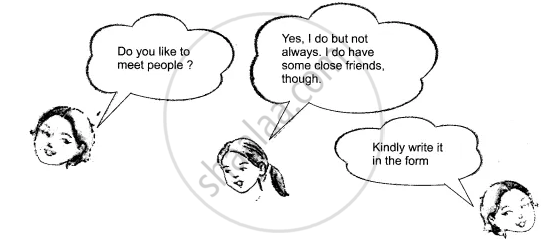
| Questions | Yes/No | Additional Response |
|
1. Do you like to meet people? |
Yes I do, but not always | I do have some close friends, though. |
|
2. Do you like the area you live in? |
No, I Don't | But I have no choice |
Here the child wants to become _______.
How does the poem, Crossing the Bar, portray the poet's deep affirmation and faith in God?
"The quality of mercy is not stained." Who say this to whom?
'The eight other athletes stopped in their tracks' means that they ______.
