Advertisements
Advertisements
Question
Discuss the following topic in groups
Most people keep dogs and cats as pets. Can you think of some unusual pets that people keep?
Advertisements
Solution
The unusual pets that people often keep are wolves, bears and tigers, snakes and even crocodiles.
RELATED QUESTIONS
Answer of these question in a short paragraph (about 30 words).
How did Santosh begin to climb mountains?
Complete the following statement.
During the Everest expedition, her seniors in the team admired her _________ while _________endeared her to fellow climbers.
Answer the following question in one or two sentences.
How did Abdul Kalam earn his first wages?
Notice how ideas are connected in the story.
Write what the following words you just used in 1.1 imply by choosing suitable options from the box.
- and:
- but:
- where:
- while:
- after:
- until:
- so :
connects similar actions, objects
denotes contrast
denotes time.
The words given above are called connectors. Connectors do not simply join sentences together; they also show how ideas are related.
There are many different ways of classifying connectors according to their meaning. We shall start with the ones you are already familiar with.
Read the comic strip based on. H.G. Wells' novells.


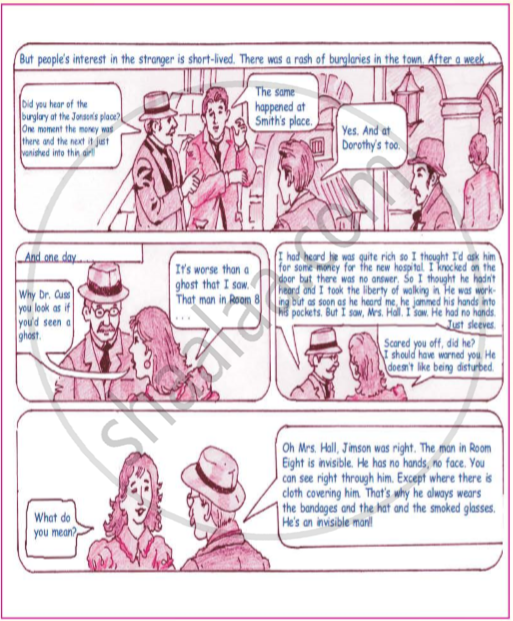
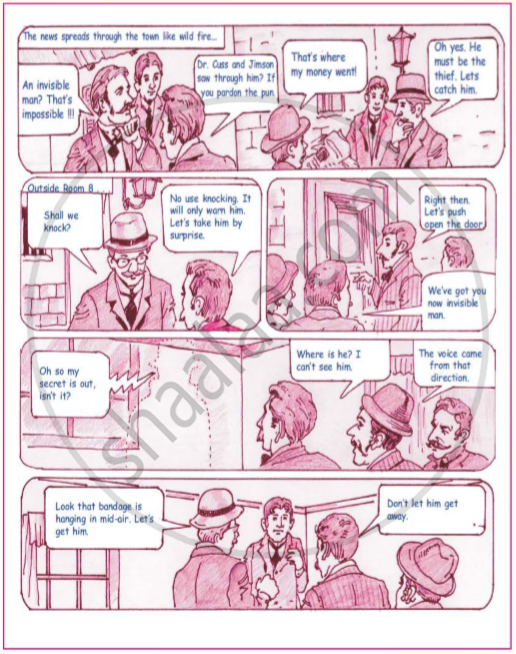
Answer the questions by ticking the correct option.
(a) The strange-looking man wanted ....
(i) the best room at the inn.
(ii} a room with a fire and a good lock.
(iii} a room with a good view.
(iv) a room where he could work quietly.
(b) Jimson was suspicious of the stranger because ...
(i} he did not answer Jimson's questions.
(ii} he did not want to talk about the weather.
(iii} he kept his back turned towards Jimson at all times.
(iv) he shouted atJimson when he entered his room.
(c) The people of the town gossiped about the stranger as ...
(i} he did not go out or talk to anyone in the town.
(ii} he had met with an accident and his face was bandaged.
(iii} he was new to the town and behaved rudely.
(iv) he stayed in his room and did not show his face to anyone.
(d) 'There was a rush of burglaries in the town. This means that ________
(i} there were many robberies in the town.
(ii) a few people in the town had seen a rob her.
(iii} the burglaries in the town were done in a rush.
(iv) the burglar was a rash and careless man.
(e) Although Jimson and Dr Cuss are suspicious of the strange guest, Mrs Hall tolerates him because ....
(i} she is not superstitious or ignorant.
(ii) she is sorry for the stranger who is bandaged.
(iii} the stranger is paying her a good amount of money for the room.
(iv} the stranger is polite and kind to Mrs Hall at all times.
(f) The stranger who was staying at the inn can be described as being ....
(I} violent
(ii} upright
(iii} dishonest
(iv) sensible
Continuous as the stars that shine
And twinkle on the milky way,
They stretched in never-ending line
Along the margin of a bay:
Ten thousand saw I at a glance,
Tossing their heads in springhtly dance.
Read the lines given above and answer the question that follow.
What is being compared to the stars and why ?
We will ponder your proposition and when we decide we will let you know. But should we accept it, I here and now make this condition that we will not be denied the privilege without molestation of visiting at any time the tombs of our ancestors, friends, and children. Every part of this soil is sacred in the estimation of my people. Every hillside, every valley, every plain and grove, has been hallowed by some sad or happy event in days long vanished. Even the rocks, which seem to be dumb and dead as the swelter in the sun along the silent shore, thrill with memories of stirring events connected with the lives of my people, and the very dust upon which you now stand responds more lovingly to their footsteps than yours, because it is rich with the blood of our ancestors, and our bare feet are conscious of the sympathetic touch. Our departed braves, fond mothers, glad, happy hearted maidens, and even the little children who lived here and rejoiced here for a brief season, will love these somber solitudes and at eventide they greet shadowy returning spirits. And when the last Red Man shall have perished, and the memory of my tribe shall have become a myth among the White Men, these shores will swarm with the invisible dead of my tribe^ and when your children’s children think themselves alone in the field, the store, the shop, upon the highway, or in the silence of the pathless woods, they will not be alone. In all the earth there is no place dedicated to solitude. At night when the streets of your cities and villages are silent and you think them deserted, they will throng with the returning hosts’that once filled them and still lover this beautiful land. The White Man will never be alone.
Let him be just and deal kindly with my people, for the dead are not powerless. Dead, did I say? There is no death, only a change of worlds.
Read the extract given below and answer the question that follow.
What does the speaker say about death? Explain.
He flungs himself down in a corner to recoup from the fatigue of his visit to the shop. His wife said, “You are getting no sauce today, nor anything else. I can’t find anything to give you to eat. Fast till the evening, it’ll do you good. Take the goats and be gone now,” she cried and added, “Don’t come back before the sun is down.”
Read the extract given below and answer the question that follow.
Where had Muni gone and why?
She again rubbed a match on the wall, and the light shone round her; in the brightness stood her old grandmother, clear and shining, yet mild and loving in her appearance. “Grandmother,” cried the little one, “O take me with you; I know you will go away when the match burns out; you will vanish like the warm stove, the roast goose, and the large, glorious Christmas-tree.” And she made haste to light the whole bundle of matches, for she wished to keep her grandmother there. And the matches glowed with a light that was brighter than the noon-day, and her grandmother had never appeared so large or so beautiful. She took the little girl in her arms, and they both flew upwards in brightness and joy far above the earth, where there was neither cold nor hunger nor pain, for they were with God.
In the dawn of morning there lay the poor little one, with pale cheeks and smiling mouth, leaning against the wall; she had been frozen to death on the last evening of the year; and the New-year’s sun rose and shone upon a little corpse! The child still sat, in the stiffness of death, holding the matches in her hand, one bundle of which was burnt. “She tried to warm herself,” said some. No one imagined what beautiful things she had seen, nor into what glory she had entered with her grandmother, on New-year’s day.
Read the extract given below and answer the question that follow.
What happened to the little girl? What did the people think?
Then, trying to hide my nervousness, I added, “How are you?”
“I’m fine. The question is: How are you?“
“What do you mean?” 1 asked “Something must be eating you,” he said—proud the way foreigners are when they’ve mastered a bit of American slang. “You should be able to qualify with your eyes closed.”
“Believe me, I know it,” I told him—and it felt good to say that to someone.
For the next few minutes we talked together. I didn’t tell Long what was “eating” me, but he seemed to understand my anger, and he took pains to reassure me. Although he’d been schooled in the Nazi youth movement, he didn’t believe in the Aryan-supremacy business any more than I did. We laughed over the fact that he really looked the part, though. An inch taller than I, he had a lean, muscular frame, clear blue eyes, blond hair and a strikingly handsome, chiseled face. Finally, seeing that I had calmed down somewhat, he pointed to the take-off board.
“Look,” he said. “Why don’t you draw a line a few inches in back of the board and aim at making your take-off from there? You’ll be sure not to foul, and you certainly ought to jump far enough to qualify. What does it matter if you’re not first in the trials? Tomorrow is what counts.”
Read the extract given below and answer the question that follow.
Why did Jesse Owens foul the first two jumps in the trial?
Suddenly all the tension seemed to ebb out of my body as the truth of what he said hit me. Confidently, I drew a line a full foot in back of the board and proceeded to jump from there. I qualified with almost a foot to spare.
That night I walked over to Luz Long’s room in the Olympic village to thank him. I knew that if it hadn’t been for him I probably wouldn’t be jumping in the finals the following day. We sat in his quarters and talked for two hours—about track and field, ourselves, the world situation, a dozen other things.
When I finally got up to leave, we both knew that a real friendship had been formed. Luz would go out to the field the next day trying to beat me if he could. But I knew that he wanted me to do my best—even if that meant my winning.
Read the extract given below and answer the question that follow.
Suddenly all the tension seemed to ebb out of my body as the truth of what he said hit me.
Complete the following sentence by adding the appropriate part of the sentence given below.
Many wise men answered the king’s questions, _______________.
Notice how in a comic book, there are no speech marks when characters talk. Instead what they say is put in a speech ‘bubble’. However, if we wish to repeat or ‘report’ what they say, we must put it into reported speech.
Change the following sentences in the story to reported speech. The first one has been done for you.
I accept the challenge, Your Majesty. Gopal told the king_____________________
The beggar was leaning against what in Ravi’s garden?
How the author and his friend spent the entire day?
Why did Akbar ask Tansen to join his court?
With your partner, complete the following sentence in your own word using the ideas in the poem.
Do not let a thought shrivel and die because __________________.
What feeling of the poet is exhibited in his peeping through the window?
Where was Caesar put to death?
