Advertisements
Advertisements
Question
An observer X is on an island 5500 m from a vertical cliff on the shore. A ship Y is anchored between the island and the Cliff. A blast on the ship’s siren is heard twice by X, the interval being 5s. [Velocity of sound = 330 ms−1]
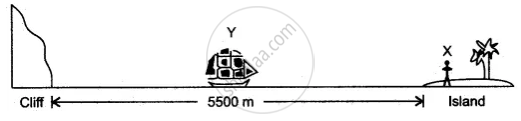
(i) Find the distance of the ship from the island.
(i) Find the distance of the cliff from the ship.
Advertisements
Solution
(i) Let the distance between the observer X on the island and the ship Y = x m
Distance between the ship Y and the cliff = (5500 – x) m
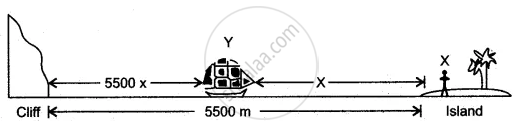
Let t1 be the time at which the first blast is heard.
∴ t1 = `"x"/"v"`
= `"x"/330` ............`("v"="Distance"/"Time")` ...........(i)
Let t2 be the time at which the second blast is heard i.e., time taken for the sound to travel from the ship to the cliff and then back to the observer on the island.
Total distance = Y to cliff + Cliff to the island
Total distance = (5500 − x) + 5500
= (11000 − x)
∴ t2 = `"Total distance travelled"/"Velocity"`
∴ t2 = `(11000-"x")/330` ...............(ii)
but t2 − t1 = 5s
∴ Subtracting equation (i) from equation (ii) we get
`(11000-"x")/330-"x"/300` = 5
∴ 11000 − 2x = 5 × 330
∴ 2x = 1100 − 1650
= 9350
x = 4675 m.
∴ Distance between the ship Y and the island = 4675 m.
(ii) Distance between ship y and the cliff
= 5500 − x
= 5500 − 4675
∴ x = 825.
The distance of the ship from the island is 4675 m and the distance of the cliff from the ship is 825m.
RELATED QUESTIONS
Which wave property determines (a) loudness, (b) pitch?
Distinguish between longitudinal and transverse waves.
When we change a feeble sound to a loud sound, we increase its :
We can distinguish between the musical sounds produced by different singers on the basis of the characteristic of sound called :
What change do you expect in the characteristic of a musical sound if its frequency is increased?
How is sound perceived by us?
What do you understand by the term sound energy?
A continuous progressive transverse wave of frequency 8 Hz moves across the surface of a ripple tank
If the wavelength of the transverse wave is 32 mm, calculate the speed with which wave travels across the surface of the water.
What is the SI unit of frequency?
Vibrations in a body produce ______.
