Advertisements
Advertisements
Question
An electromagnetic radiation is used for photography in fog. [2]
(i) Identify the radiation.
(ii) Why is this radiation mentioned by you, ideal for this purpose ?
Advertisements
Solution
(i) Infared radiation.
(ii) They have low frequency, the energy associated with them is also low so they do not scatter much and can penetrate appreciably through it.
RELATED QUESTIONS
Radiations given out from a source when subjected to an electric field in a direction perpendicular to their path are shown below in the diagram. The arrows show the path of the radiation A, B and C. Answer the following questions in terms of A, B and C.
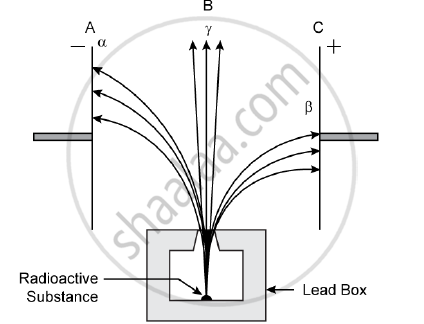
1) Name the radiation B which is unaffected by the electrostatic field.
2) Why does the radiation C deflect more than A?
3) Which among the three causes the least biological damage externally.
4) Name the radiation which is used in carbon dating.
When is said to be the nucleus unstable?
What do you mean by Atomic number
A radioactive nuclide `""_86^226` Ra decays by emission of two alpha particles, one beta particle and gamma rays. Which of the following is the resulting nuclide X?
A certain nucleus A (mass number 238 and atomic number 92) is radioactive and becomes a nucleus B (mass number 234 and atomic number 90) by the loss of one particle.
What particle was emitted?
What are the types of emission?
What is meant by Radioactivity?
What is the value of the speed of gamma radiations in air or vacuum?
The mean lives of a radioactive substance are 1620 and 405 years for β-emission and β-emission respectively. The time after which three fourth of a sample will decay if it is decaying both by β-emission and β-emission simultaneously will be ______ years.
(Take ln 2 = 0.693)
In the discovery of radioactivity, why could the darkening of the covered photographic plate NOT be explained by ordinary visible light?
