Advertisements
Advertisements
Question
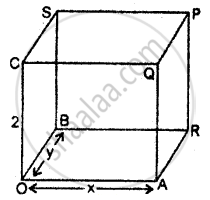
A tank with rectangular base and rectangular sides, open at the top, is to the constructed so that its depth is 2 m and volume is 8 m3. If building of tank cost 70 per square metre for the base and Rs 45 per square metre for sides, what is the cost of least expensive tank?
Advertisements
Solution 1
Let l, b, and h be the length, breadth, and height of the tank, respectively.
Height, h = 2 m
Volume of the tank = 8 m3
Volume of the tank = l × b × h
∴ l × b × 2 = 8
\[\Rightarrow lb = 4\]
\[ \Rightarrow b = \frac{4}{l}\]
Area of the base = lb = 4 m2
Area of the 4 walls, A= 2h (l + b)
\[\therefore A = 4\left( l + \frac{4}{l} \right)\]
\[ \Rightarrow \frac{dA}{dl} = 4\left( 1 - \frac{4}{l^2} \right)\]
\[\text { For maximum or minimum values of A, we must have }\]
\[\frac{dA}{dl} = 0\]
\[ \Rightarrow 4\left( 1 - \frac{4}{l^2} \right) = 0\]
\[ \Rightarrow l = \pm 2\]
However, the length cannot be negative.
Thus,
l = 2 m
\[\therefore b = \frac{4}{2} = 2 m\]
\[\text { Now,} \]
\[\frac{d^2 A}{d l^2} = \frac{32}{l^3}\]
\[\text { At }l = 2: \]
\[\frac{d^2 A}{d l^2} = \frac{32}{8} = 4 > 0\]
Thus, the area is the minimum when l = 2 m
We have
l = b = h = 2 m
∴ Cost of building the base = Rs 70 × (lb) = Rs 70 × 4 = Rs 280
Cost of building the walls = Rs 2h (l + b) × 45 = Rs 90 (2) (2 + 2)= Rs 8 (90) = Rs 720
Total cost = Rs (280 + 720) = Rs 1000
Hence, the total cost of the tank will be Rs 1000.
Solution 2
Let the length of a rectangular tank be x meters and width y meters.
Depth of the tank = 2 meters
∴ Volume = 2 × x × y
= 2ry = 8 (Given)
xy = 4 …(1)
Area of the rectangle = ry
Base cost rate = Rs. 70/m2
∴ expenditure incurred on the basis = 70xy rs.
area of the four walls
= 2 (x + y) × 2 = 4 (x + y) m2
Rate of expenditure on walls = Rs. 45 per m2
Total cost on walls = 48 × 4 (x + y) = Rs. 180 (x + y)
Total cost of foundation and walls,
C = Rs. [70xy + 180(x + y)] ...(2)
From equation (1), on putting y = `4/x` in equation (2),
C = `70 xx 4 + 180 (x + 4/x)`
`= 280 + 180 (x + 4/x)`
On differentiating with respect to x,
`(dC)/dx = 180 (1 - 4/x^2)`
`= 180((x^2 - 4)/x^2)`
For maximum and minimum, `(dc)/dx = 0`
`=> 180 *(x^2 - 4)/x^2) = 0`
`=> 180 (x^2 - 4) = 0`
`=> x^2 - 4 = 0`
`=> x^2 = 4`
∴ x = ± 2
When, x = 2, y = `4/2 = 2`
Again, `(d^2 C)/dx^2 = 180(8/x^3)`
At x = 2 `(d^2 C)/dx^2 = 180 (8/8) = 180` = +ve.
⇒ C is the minimum.
minimum expenditure at x = 2 = 280 + 180`(2 + 4/x)`
`= 280 + 180 xx 8/2`
= 280 + 180 × 4
= 280 + 720
= Rs. 1000
Notes
The solution given in the book is incorrect. The solution here is created according to the question given in the book.
